ANU wins the student moot, but why does it matter?
ANU’s winning moot team, from left, Alexandra Fladun-Dorling, Rania Saud and Georgia Bowrey.
The ANU team of Alexandra Fladun-Dorling, Rania Saud and Georgia Bowrey won the grand final of the ACT Annual Intervarsity Moot against UC’s team of Grace Huang, Grace Ferguson and Dakota Thorne on Wednesday. Legal columnist HUGH SELBY was there.
A law student mooting competition. What’s that? Does it matter? What makes it worthwhile?
Hugh Selby.
A moot is a simulated appellate hearing (a court proceeding where a higher court reviews a lower court’s decision to see if a legal mistake was made). The opposing parties are given the decision of a first-instance judge about technical legal points.
One or both parties may be appealing the decision. That’s because the judge may have found for one party on one point, but for the other party on another point. Both hope to maintain the win on the point that favours them and overturn the point decided against them.
The accepted facts are those contained in the judge’s decision. Hence, there is no questioning of witnesses.
However, that doesn’t mean that missing facts should be overlooked. On the contrary, remembering that most cases are decided on the facts, any appellate lawyer is looking for missing facts – especially those that, being absent, undermine the strength of the earlier single-judge decision.
A moot introduces tomorrow’s lawyers to practical skills that they can develop over the next half century.
Why it matters
Nearly everyone grasps that to master a skill, a dedication to book learning and listening to a teacher, even if the books and the teachers are good, are not enough.
And that’s the case whether the skill is to be a surgeon, a pilot, a qualified tradie, a renowned chef, a theatre nurse, good at any sport or any occupation you can think of.
There’s no substitute for practical experience because that’s when what’s in the head has to be expressed through activity that succeeds or fails.
While it’s true that some very talented people can perfect skills by their own efforts, the more usual reality is that turning theory into practice needs the help of one or more good mentors who can explain, demonstrate, observe, and give insightful encouraging feedback.
Good mentors bridge the gap between a learner’s mental grasp of concepts and methods and the practical demands of the real world.
But mentoring can only take the student so far. Improving a skill requires not only its repetition but the capacity to reflect upon a performance, work out the path to self-improvement, and then give that path a go; that is, take the risk, prepare to be proved wrong, but always intent on doing better next time.
Not being open to taking such risks is the reason that many, indeed most, law students shy away from presentations in front of others.
In that respect they are no different to most of us, regardless of our origins. Public performances in front of audiences, large or small, cause fear.
For that small percentage who opt to take the risk there is the hope to become a barrister, a lawyer who specialises in weighing up the evidence, sorting out the applicable law, and presenting that evidence and the law before a court or tribunal.
Bluntly, the actual training to become an effective, on the feet, barrister is less than ideal. Too much has to be packed into too little time. The result is that rather too much has to be learned at the school of hard knocks.
Which is why encouraging college students who take legal studies to have a go in the witness examination competition is important, as is encouraging law students to compete in the university law schools’ witness examination competitions and any moots they can find.
What these competitions offer are mentors for preparation and useful feedback on performances – both of which are so rare during working life as a lawyer.
So moots, especially those sponsored by the legal profession, and leading to appearances before current or retired judges, really do matter to the future standards of the legal profession and our justice system.
This past month the ACT Bar Association has run the Annual Intervarsity Moot with teams from the law schools of the University of Canberra and the Australian National University opposing each other in elimination rounds.
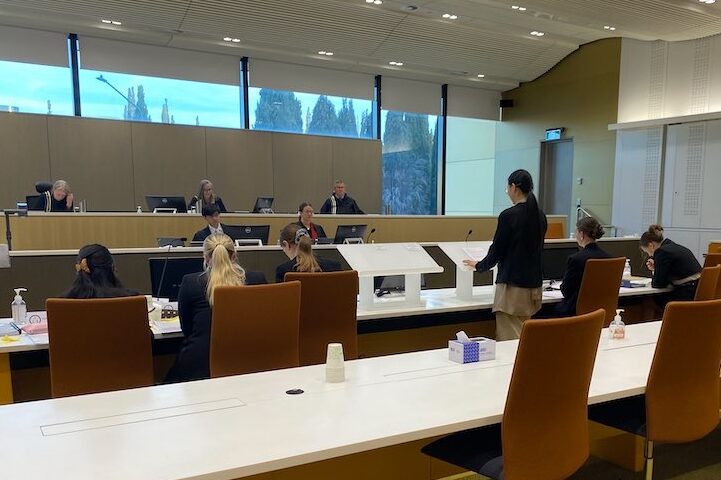
On the last day of September the final round was before the ACT Supreme Court’s Chief Justice McCallum, Justice Baker and Justice Muller.
UC’s Grace Ferguson, who won the moot’s award for best speaker, is on her feet before the Supreme Court bench. Photo: supplied
What makes it so worthwhile
What happened between the advocates (all young women) and the judges showed just how worthwhile this experience is to our future advocates.
There are performance points, easy to state, but harder to follow, such as pausing to check that the bench is following, being very careful with voice speed, laying out a road map that is followed and repeated, having notes that are formatted so as to be useful when on one’s feet and having to maintain eye contact with the judges, and avoiding stating, “I believe” – personal beliefs having no part in a legal argument.
The judges interjected with “real” queries – the kind that occur in practice. For example, pointing out that one of the cases relied upon had been later taken to the High Court. Therefore, the proper reference was the High Court decision, not the earlier one.
Another example, a judge asking for elaboration on an argument assertion. This is a hard to learn lesson – being able to tease out a proposition and show how it can, and cannot be applied. Good preparation includes thinking about what will be of interest to the bench.
Another hard lesson was when an advocate was repeatedly pressed by a judge to state what evidence the prosecution had of an intent by the accused to murder. There was no such evidence (at least not on the facts in the first instance decision).
Sometimes, all that can be said is, “Today I have no such evidence”. That’s hard to say. Then the advocate looks for a reason to minimise any adverse inferences that might affect the points being decided on the appeal.
One of the legal points was whether a jury could be told about a now deceased witness claiming to have seen the accused take a gun from a gun locker. The claim was made some time after the alleged event and there was no evidence that the gun removed (if that happened) was the gun used in a murder.
It was good to hear the student advocate pointing out that removing a gun from a gun locker is not especially noteworthy, so not well remembered, in a rural setting, but could be in a suburban home when observed by a non gun user person.
It’s also important, as one advocate did, to explicitly recognise the opposing argument and then rebut it, or at least minimise its strength.
The Chief Justice made the same point to both sides about what some facts might entail. It was a pivotal point. Comfortable, experienced, appellate barristers look for, and respond to judge’s queries, because such queries may be hooks on which to attach an argument.
Put another way, a question from the bench is not always an obstacle. It may be an opportunity.
That’s a gloss which is some years in the future for these student mooters.
For this moot, the student aims were to appear confident, to write and speak persuasively, to answer the judge’s questions, to avoid being flustered, and to get a sense of, “I enjoyed this. I want to do it again, for real”.
For now they can be proud of their effort and appreciative of the real experience they had in the courtroom.
Let’s hope that the local profession ensures that this competition, along with witness examination, becomes an exciting, annual event.
Just as we all hope for good medical care delivered by competent, caring practitioners, so – if we are unlucky and have to go to court – we want lawyers who are truly skilled. The student mooters gave hope for that future.
Former barrister Hugh Selby is the CityNews legal affairs columnist. , author of the free podcast Advocacy in Court: preparation and performance and co-editor with ACT barrister Graeme Blank of Appellate Practice.
A rural shopper could face a 165km round trip to pick-up a package, while the national postal service dominates the parcel market, an inquiry has been told.







Leave a Reply