By Helen Musa
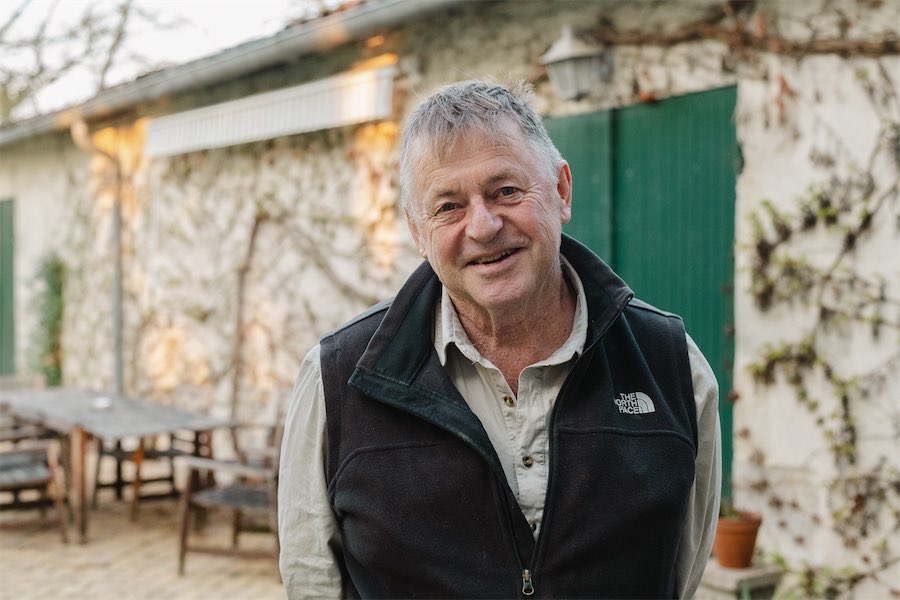
The 16th edition of Sculptures in the Garden in glorious Mudgee is about to be launched and Canberra artist and letter cutter Ian Marr has been selected to show his work there, vying for part of the $60,000 prize pool.
The line-up, including a number of high-profile artists and entrants from Queensland, NSW, the ACT, Victoria and Tasmania, will show around 300 works and a new event, My Kingdom for a Horse, will see visitors, guided by artists, help build a growing herd of life-sized horse sculptures across the 16-day festival.
Ian Marr has had a long artistic career and his work is held in many public and private collections.
Readers may recall that his 2016 Mintaro slate sculptural piece, A Literary Map of the Molonglo, was gifted to and installed at the National Arboretum. The work follows the writers and artists who made their lives here. Les Murray’s words, for instance, are placed where Downer is.
When we catch up at the heavy-duty ANCA studios in Mitchell, he reveals to me that many people working in stone never think of themselves as artists.
Rather, they act as ciphers for the words of others.
Marr tells me it was artist, Eric Gill (who died in 1940), who revived direct stone carving using a traditional hammer and chisel.
Gill, he says, “combined the passionate spirit with mark-making, with the fierce physical business of carving”.
Marr certainly counts himself an artist.
“Putting language into a public space brings together the way poetic text, suggested to you, will be changed by being carved into a physical object,” he says.
On the rare occasions when he takes commissions for memorials, he first asks whether there was any poetry that moved the people involved.
A good role model for him was the Scottish artist and poet Ian Hamilton Finlay, whom he visited in 1976.
“He told me, ‘You must visualise the words’,” Marr recalls.
Marr spent his childhood at Mount Murchison station outside Wilcannia, which he and his family have now reserved as a biodiversity conservation area. He still works there and at his Canberra studio, combining land management with drawing, painting and letter-cutting.
He began carving sandstone in the early 1990s in what he calls “the crudest possible way”, using chisels from the local hardware store.
“I got better. I bought better tools.”
He went on to take masterclasses in drawing and letter-cutting in Australia and his travels led to visits and residencies in Ireland, Scotland, France, Italy, Finland, Northern Ireland, China and elsewhere.
“I became friends with people whose work I admired, seeking out the people where knowledge was.”
While participating in a drawing marathon in Adelaide in 1997, he found an old laboratory bench from Adelaide University in a salvage yard. It turned out to be Mintaro slate from near Clare, a material that has become central to his practice.
But sandstone remains equally important.
“Sandstone is living stone that collects life growing on it,” he says. He’ll be demonstrating his carving on sandstone during the festival.
On the whole, Marr’s work is secular unless commissioned otherwise.
“For special projects I work as directed and I’m happy to do commissions. I try not to say no.”
Even though Marr considers himself a modest gardener, he believes great gardens lend themselves readily to his art. He cites places such as Cloudehill Gardens in Victoria’s Dandenong Ranges.
Two works by Marr have been accepted into the Mudgee sculpture prize. Modestly, he does not regard them as spectacular enough to be considered major sculptural works, but he is pleased to have been invited.
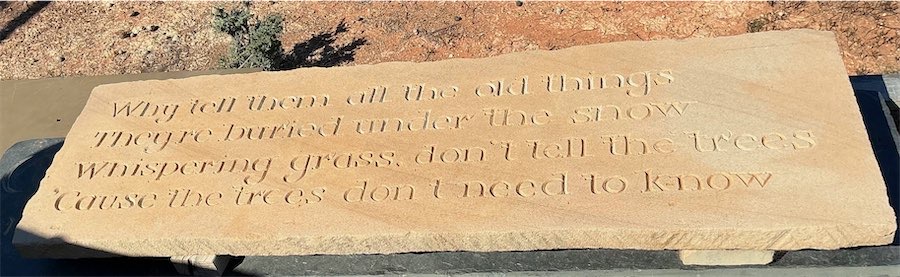
One, Whispering Grass, in sandstone, uses the final lines of the popular 1940 song with words by Tin Pan Alley publisher Fred Fisher. The other, Candide, executed in Mintaro slate, takes the closing words of Voltaire’s 1759 satire: “That is well said, but we must tend to our own garden”.
That, Marr says, was the French philosopher’s pragmatic response to a chaotic world.
And thus, he adds, “artists and craftspeople, like gardeners, find their meaning in making”.
Sculptures in the Garden Festival, Rosby Wines & Gallery, Mudgee, opening night October 9, then running until October 25.
News all day, every day at CityNews.com.au.
Who can be trusted?
In a world of spin and confusion, there’s never been a more important time to support independent journalism in Canberra.
If you trust our work online and want to enforce the power of independent voices, I invite you to make a small contribution.
Every dollar of support is invested back into our journalism to help keep citynews.com.au strong and free.
Thank you,
Ian Meikle, editor


Leave a Reply