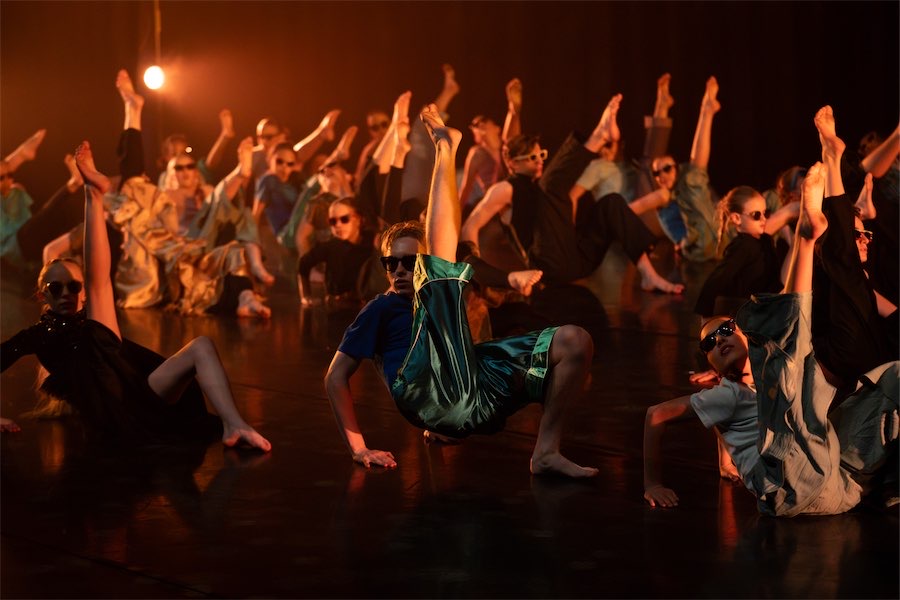
Dance / We Come Together to Dance, Quantum Leap Australia. At Belconnen Arts Centre, Canberra, until October 17. Reviewed by MICHELLE POTTER.
We Come Together to Dance is the 2026 production for Quantum Leap Australia’s Chaos project.
Chaos has been an annual event for Quantum Leap Australia for many years now and the 2026 production sets out to show different aspects of why and how the art of dance engages aspiring artists of various genders and ages.
Four professional dancers and choreographers, Pat Hayes Cavanagh, Alice Lee Holland, Gabriel Sinclair and Isabella Stone, worked with a cast of 40 dancers of various ages.
The choreographers, with input from the dancers, created an opening and a closing piece along with five sections in between. These mid-sections focused on different reasons for coming together: To Dance ‘Til We Drop, To Grow, To Come Together, To Be Who We Are, and To Belong.
Choreographically, I thought We Come Together to Dance was quite repetitive. My impression was that the hand and arm movements were quite sharp and geometric in pretty much every section.
There was also a lot of running across the stage space and several occasions when gymnastic movements, such as hand stands, cartwheels and forward rolls, were inserted.
In addition, in the past I have always enjoyed the way Chaos projects have created various arrangements of dancers in appealing groupings. There were efforts to do this at various stages of We Come Together to Dance, but the appeal was lost when the dancers had not been rehearsed sufficiently to hold the groupings together in an adequate manner.
Lighting by Owen Davis (and the choreographers as the program notes state) was a highlight. It often took in the audience in a small but not overly annoying manner, which perhaps suggested that we too had come together if not to dance but at least to watch others dance.
Sound, as mastered by Kimmo Vennonen, was contemporary and varied and came from composers from around the world, including from Belgian musician Stromae and the English band Spandau Ballet.
Costuming was attractive at times, especially in parts of one section where black, gold and sparkly items were apparent. But in many sections the costuming was overly varied in colour and style. Simplicity and similarity are often better.
The opening section, in which all 40 dancers occupied the performing space, and in which all 40 of them were wearing sunglasses, was definitely a somewhat startling beginning.
But We Come Together to Dance was far from my favourite Chaos project from the many I have seen over the years.
The use of the word chaos as the title for an ongoing production idea has always made me think of the development process. But for me this 2026 Chaos project was chaotic on stage as well.
I’m hoping that next year’s Chaos project will feature a stronger overall appearance and less repetitive movement.
News all day, every day at CityNews.com.au.
Who can be trusted?
In a world of spin and confusion, there’s never been a more important time to support independent journalism in Canberra.
If you trust our work online and want to enforce the power of independent voices, I invite you to make a small contribution.
Every dollar of support is invested back into our journalism to help keep citynews.com.au strong and free.
Thank you,
Ian Meikle, editor


Leave a Reply