News location:

Wednesday, September 23, 2026 | Digital Edition | Crossword & Sudoku

Supporting the outdated tram endangers the future

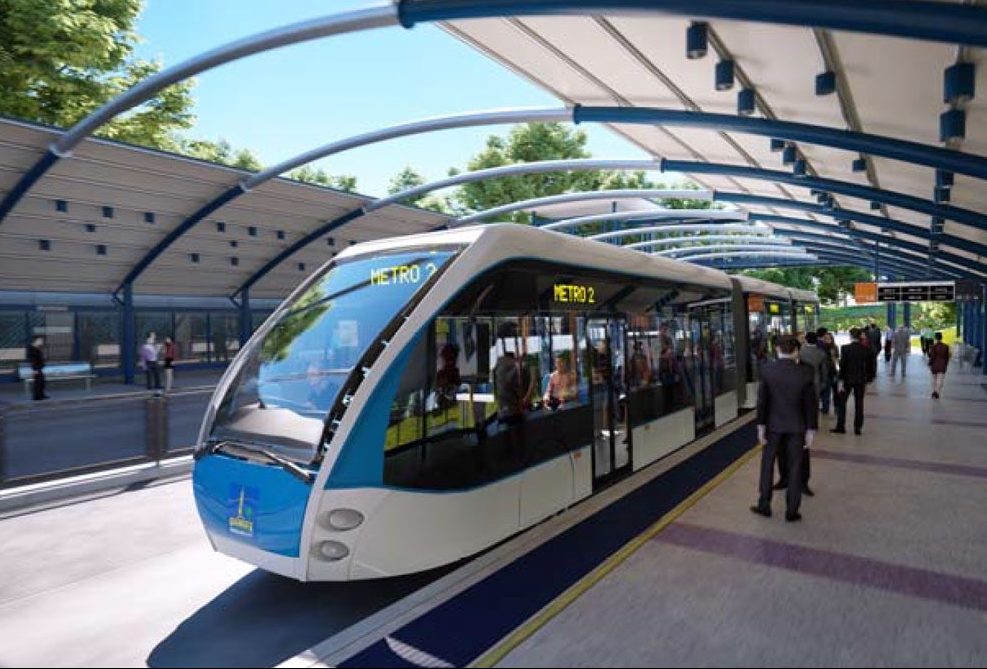
The Brisbane City Council Metro (buses)…look like light rail and trackless trams and provide all the comforts of the latter two. Photo: Brisbane City

“If the absurd light rail network is not stopped, how will we answer the next generation when they ask: “Why did you permit the government to shoulder us with great debt for a slow, outdated transport system?” writes BEATRICE BODART-BAILEY.

Can someone please explain to me why we should be embedding magnetic nails into our roads and rip them up to fortify them for the weight of trackless trams?

Prof Beatrice Bodart-Bailey.

Especially when the latest buses, such as those in Brisbane, look like light rail and trackless trams and provide all the comforts of the latter two.

The big advantage of Bus Rapid Transit (BRT) is that – as our Rapid buses already do today – they service not only the main lines, such as Civic to Woden, but also take passengers further to where they live without having to get up from their seats.

For instance, the R4 bus continues from Woden on to Tuggeranong at one end and from Civic to Belconnen at the other and could go to further outlying suburbs if required.

With only the modest expense of providing “bus only” priority lanes throughout, this service would be even more rapid and certainly preferable to the government’s documented plan of turning the R4 into a local bus between Lanyon and Woden, forcing commuters from Tuggeranong to change to a slow tram at Woden, trackless or not, winding its way around the parliamentary triangle to Civic.

Am I the only person who is amused when those supervising the endless trucking of soil for the new 1.7 kilometres of tramline justify the cost, the traffic problems and pollution the work is causing with the claim that they are laying the foundations for the transport of the next one hundred years? 

A claim made in an age where one’s car is out of date in 10 years, one’s laptop in five and one’s phone even earlier, and robotaxis are already providing efficient transport in several US cities.

By the time the government promises the first rides on the Civic-to-Woden tram, robotaxis and robo-buses of all sizes are likely to provide efficient door-to-door transport for the decreasing numbers of commuters elsewhere and the only long-enduring item left in Canberra is the debt created by the present government.

As to the criticism of developers and those investing in luxury accommodation that BRT does not give the assurance that there will be permanent stops to justify investment in housing construction, one might ask whether such concerns should have priority over efficient transport for the rest of the public not plagued by such thoughts.

Moreover, the government could provide assurance for continued operation by furnishing stops and buses with the new Chinese fast-charging battery system that can add 400 kilometres of range in just five minutes, eliminating the cost for new bus depots and for having to keep buses out of circulation for charging.

Further, more elaborate bus stops where small convenience shops are combined with seated waiting areas protecting passengers from the increasingly bad weather of climate change would contribute to the convenience of public transport and the feeling that the stop is there to stay.

Then there is the erroneous claim that decades of Labor rule indicates that the public loves the tram.

Certainly, those who can afford to live next to a stop love it, but that is at most 10 per cent of Canberra’s population. The rest must pay for it and is motivated to vote Labor by the opposition’s threat to abolish public service jobs rather than a tram, which is of no use to the majority.

The loss of the Greens at the last election, as initiator of the tram, does not support the assumption that the tram is a vote-winner, especially now that the financial cost is becoming apparent.

In fact, the construction of the tram is unlikely to have been tolerated if in 2012 the government had not deceived the public by keeping secret the comparison of light rail with BRT, which was documenting that the latter would cost half and bring twice the income plus the same development of the area.

Did the then chief minister, our present federal minister for finance, fail to understand that accepting to pay twice the amount for light rail than BRT for the initial line, the comprehensive Canberra transport network crossing the lake planned by the Greens would cost at least double the amount of an equivalent BRT network?

Has the present chief minister any idea how to finance the next step of this grandiose plan when the government debt per person of the ACT’s population is already a multiple of the similar per person debt of the rest of Australia’s population?

I’m not a fan of Elon Musk, but his recent statement that supporting the outdated endangers the future contains a kernel of truth. 

For Canberrans it means that if the absurd plan of covering the ACT with a light rail network multiple the cost of BRT is not stopped now, how will we answer the next generation when they are old enough to ask “why did you permit the government to shoulder us with great debt for a slow, outdated transport system, downgrading the environment and sacrificing trees of our bush capital?” 

Historian Beatrice Bodart-Bailey is an honorary professor at the ANU School of Culture, History and Language and an emeritus professor of the Department of Comparative Culture, Otsuma Women’s University, Tokyo.

News all day, every day at CityNews.com.au.

Who can be trusted?

In a world of spin and confusion, there’s never been a more important time to support independent journalism in Canberra.

If you trust our work online and want to enforce the power of independent voices, I invite you to make a small contribution.

Every dollar of support is invested back into our journalism to help keep citynews.com.au strong and free.

Become a supporter

Thank you,

Ian Meikle, editor

Share this

5 Responses to Supporting the outdated tram endangers the future

Jim says: 15 July 2025 at 8:49 am

If it is so slow and so outdated, why are there multiple major cities around the world that continue to either re-instate or upgrade their tram systems, and make them integral to their overall public transport system.

None of that is to say the Tram is the best solution for Canberra – but trying to sell it as some form of outdated technology, when it is in fact not, is not the strongest of counter-arguments.

And you should actually prove claims like: “bring twice the income plus the same development of the area.”

The business case didn’t say that at all.

Reply
B. M. Bodart-Bailey says: 15 July 2025 at 9:59 pm

Thanks for your comment, Jim. I am referring to the 2012 “City to Gungahlin Transit Corridor: Concept Design Report” by the company URS commissioned by the ACT government to compare light rail transit (LRT) with bus rapid transit (BRT) and the “do-nothing scenario”. I was able to consult this initially commercial-in-confidence report as a simply typed version on the internet in early July 2022 for an article that subsequently appeared at https://www.canberraplanningactiongroup.com/post/walter-burley-griffin-s-canberra-and-his-tramway-the-ideal-city-of-the-future-part-two-of-three. This early version of the URS report stated on page 85 that BRT had roughly twice the benefit-cost ratio of light rail. Strangely, this simple document was soon after replaced by a much shorter version well set out with photo material and graphs and less text. However, the then Minister for the Environment and Sustainable Development, Simon Corbell, let it slip that BRT would bring more than twice the profit of the LRT system, quickly adding that LRT was even less cost effective in Queensland and NSW, but that in Canberra a revised submission would strengthen the business case on land development uplift. (On how this is done see Jon Stanhope & Khalid Ahmed “Inflate ‘city shaping’ benefits and, bingo, it all adds up!”, CN June 24).
As to your “multiple major cities around the world” argument: sometimes it might make economic sense to extend an existing line in a busy commercial area, but could you name the cities that are burdening the public with an equivalent amount of money and C02 for a 1,7 km extension?

Reply
Jim says: 16 July 2025 at 11:11 am

Please do show where Minister Corbell spoke about ‘Profit’ – I want to see the actual words from Hansard or a reputable source. There is no reference provided in your link to said claims – but it must exist if he ‘let it slip’.

The fact you continue to reference ‘profits’ as some sort of deciding factor when comparing options under a CBA for public transport suggests a limited understanding of how CBAs are structured, or what they quantify, demonstrate or can be led to conclude. Let alone the simple fact public transport systems do not generally have a public motive at their centre (bar a notable example or two) – and certainly not within the ACT context.

There are multiple cities around the world that have built brand new lines, not just extended existing lines in recent years – it doesn’t take much to find details – https://en.wikipedia.org/wiki/List_of_tram_and_light_rail_transit_systems (Yes I’m not going to claim wiki is 100% accurate as a source, but that provides a decent summary, and if one is really interested, it is easy enough to look up the wide range of projects highlighted there).

Some extensions of existing lines, but a lot are new networks as well. I never made claims about price etc. But the fundamental claim that it is an outdated technology is not reflected in the actual evidence from across the world, where a wide range of decision makers in a wide range of circumstances have decided it is a viable and fit for purpose option in the 21st century.

Reply
B. M. Bodart-Bailey says: 17 July 2025 at 11:18 am

If you had followed up the https of my last reply, you would have been able to locate the article “Light rail best choice for Canberra’s future” in the publication My Gungahlin, of 30 July 2013. Here Minister Corbell is quoted as revealing that the confidential URS report established that the benefit cost ration of LRT was 2.34, compared to BRT’s of 4.78. The article explains that “Benefit cost ratio is a key indicator of a project’s viability. A ratio greater than one demonstrates that for every $1 spent there is a positive economic return” in other words, a profit. If the government had paid more attention to the “viability” and “positive economic return” of the chosen mode of public transport, we would not be in a position now where the Financial Times of 14.7.2025 notes with regard to the ACT’s financial situation that “Debt exceeds $30,000 for each of the almost 500,000 adult and child Canberrans.”
The Wikipedia entry on trams is interesting, showing how developed countries have extremely few or no new tram lines after 2012 when EV buses became viable. Developing countries, on the other hand, start new tram lines around that date. What seems to have happened is that out-of-date tram carriages were “donated” or sold cheaply to the poorer nations. The same happens with ships and cars. Travelling in Southeast Asia you will often find ferries etc. still with their old markings in Japanese or another to that country foreign language.

Reply
David says: 16 July 2025 at 9:12 am

Basically its a good idea anywhere in the world except Australia. Not because the concept isn’t sound but because everything costs too much and is too slow to build in Australia. Given that costing too much to build has a strong correlation with the housing crisis, that everyone has a problem with (except tax payer funded landlords), you would think the critics would actually be focused on why it is costing so much…..

Reply

Leave a Reply

Your email address will not be published. Required fields are marked *

*

*

Related Posts

Opinion

Cartoon / Dose of Dorin

Unfortunately, it'll take more than yoga to stop the RBA lifting interest rates next Tuesday, says cartoonist PAUL DORIN.

Follow us on Instagram @canberracitynews