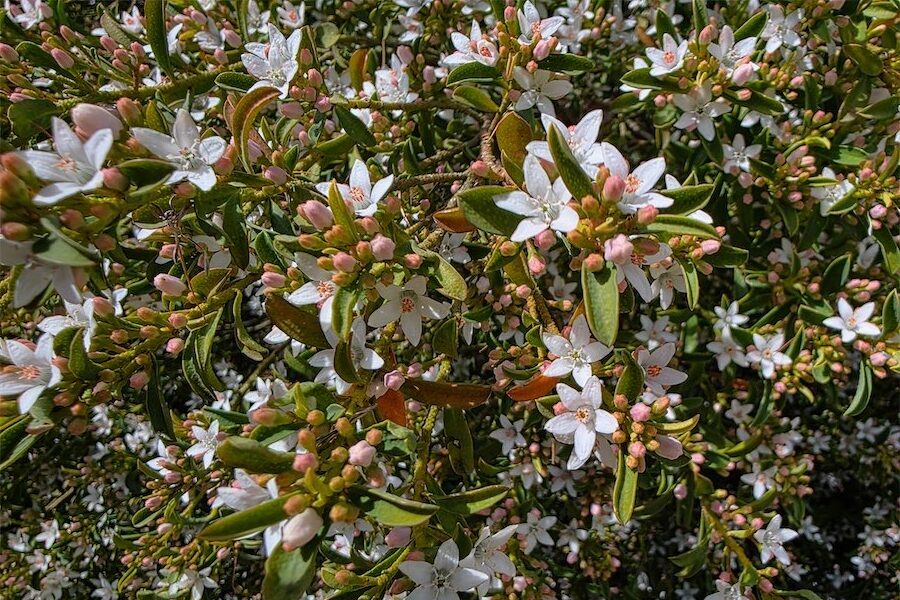
The wax flower… a small, hardy shrub, with star-like white flowers, which grows in shade and full sun. Photo: Jackie Warburton
Hardy, aromatic and drought tolerant, wax flowers bring masses of white blooms to the spring garden while attracting bees, says gardening columnist JACKIE WARBURTON.
Early spring is one of the best times to see native plants in full flower.
Jackie Warburton.
One of the hardiest, requiring little or no care, is the wax flower (Philotheca myoporoides).
This small, hardy shrub has star-like white flowers and grows in shade and full sun. It is useful as a clipped feature plant or can be grown as a hedge to a metre tall.
The foliage is aromatic, grey in colour and drought tolerant once established. Plant it where there is water nearby and its flowers will attract bees to the garden.
Two different varieties grow well in our climate. One is Profusion, which lives up to its name when in flower. It is a larger plant, growing to 1.5 metres tall.
If space is at a premium, the smaller Winter Rouge is more suitable for pots and hedging paths.
NOW is the time to prune maples while they are in their growing phase.
Overall, take as little off your tree as possible, removing whole branches back to the trunk. Removing branches from the centre will improve airflow and ensure there are no spaces for aphids to hide.
Remove dead, diseased or damaged wood, along with crossing branches, and keep the watering maples during the summer months.
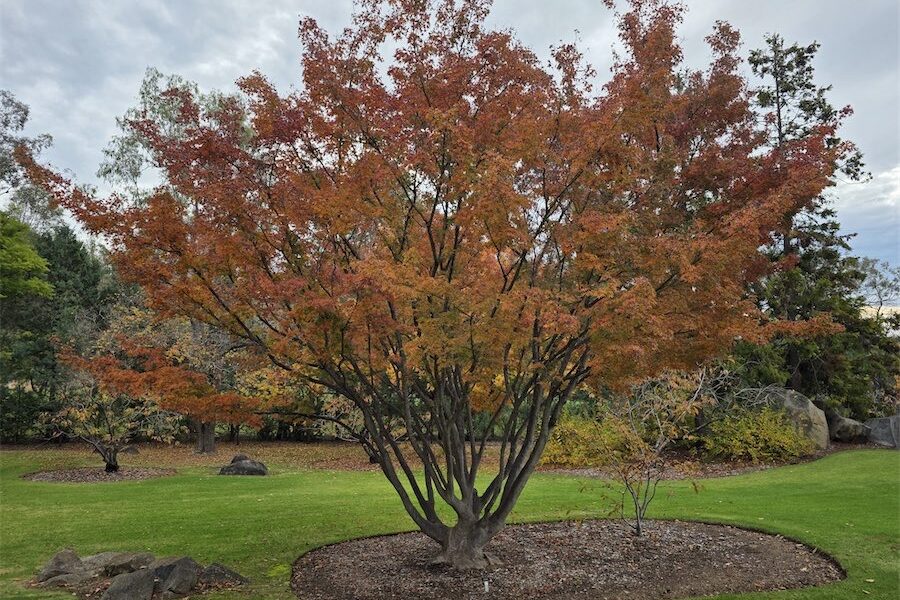
The delicate foliage of Japanese maples… more suited to shade, pots and smaller gardens. Photo: Jackie Warburton
THERE are differences between Chinese maples (Acer truncatum) and Japanese maples (Acer palmatum), mainly in their climatic requirements, growth size and leaf structure.
Chinese maples are generally tougher than their counterparts. They are also much larger trees, such as Trident maples, while still putting on colourful autumn foliage.
Japanese maples are more suited to shade, pots and smaller gardens, with much more delicate foliage. They are highly prized as weeping standards and can live for many years. Japanese maples are also the most successful in bonsai and grow well in small gardens or on balconies.
If you are looking to put a maple in the garden, plant it where it receives morning sun with protection from westerly winds and the hot afternoon sun.
Maples have shallow root systems and can dry out very quickly, so keep them moist and mulched.
The time to buy a maple for the garden is when it is growing and in full leaf, but the optimum time is in autumn, when its colourful foliage is on full display.
IN the garden, bulb foliage is dying down, so this is the last chance to apply fertiliser to help store nutrients for next year’s growth.
The mass of foliage can be bunched together and tied with organic string. It can be cut and removed six weeks after the flowers have finished.
If clumps of bulbs did not flower well this year, there could be several reasons. If they are overgrown or too deep in the soil, they will not flower.
Generally, bulbs should be planted at only twice the depth of the bulb. They also need at least four hours of sun each day, so overshading trees can prevent flowering.
Bulbs can be lifted after flowering and stored in a cool, dark place until autumn. If leaving them in the garden, ensure they are not overwatered while dormant.
THE vegetable garden should be ready for planting summer crops as the soil warms over the next few weeks. There is still plenty of time to plant a few seeds into seed-raising mix and keep them moist on a windowsill.
Once there are a few sets of leaves, pot seedlings into the next-size pot. If the stems are strong enough, they can be planted into the garden. Place diatomaceous earth around seedlings to keep insect pests at bay.
Jottings
Direct sow flower seeds of zinnias and cosmos.
Tie up berry canes as they grow.
Prune viburnums once they have finished flowering.






Leave a Reply