Columns confirm we’ve got the government we deserve
Flag of the ACT. Photo: ACT Government
“Why worry if a woman in custodial care gets $100,000 medical compensation. It’s only other people’s money,” says letter writer ANTHONY HORDERN.
Three stories (CN September 24) confirm that Canberra electors get the government they deserve.
Columnist Michael Moore shows how incompetence adds $130 million “compensation” to the $2 billion trams deficit.
Planner Richard Johnston draws attention to the NCA draft amendment allowing 15-storey buildings around Hume Circle, arising from secret discussions with “developers”.
Gwyn Rees points out that the Greens gambling tax “doesn’t add up”.
I’m not surprised the Greens can’t add up, since their philosophy is that “funding” (it’s different from money, you know) simply falls from the sky.
The NCA demonstrates Canberra’s “swerve to Asia”, with Shanghai Towers housing more Australians. Why do we need those wasteful “Garden City” homes anyway? They only make trams more inefficient.
And why worry if a woman in custodial care gets $100,000 medical compensation. It’s only other people’s money.
Albert Einstein said, doing the same thing over and over, hoping for a different outcome, is the definition of insanity.
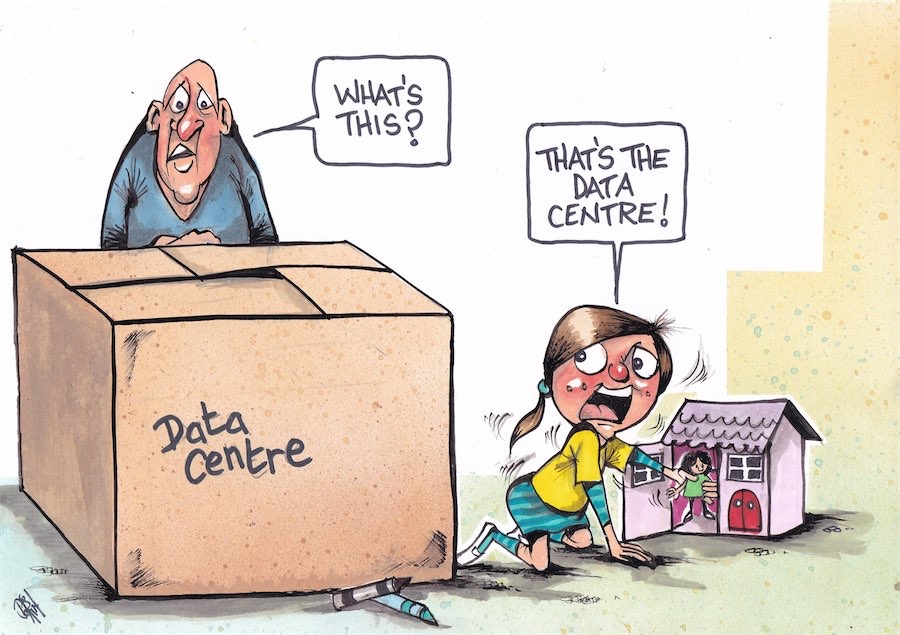
The folly of the Australian government’s “open arms” approach to AI and building large data centres was recently demonstrated by the prime minister’s confirmation that OpenAI’s AI agents had accessed Medicare health statistics held by Services Australia.
This example underlines a lack of preparedness and foresight and has been flagged by many in the community. It could well be that the government will soon be fighting AI “bushfires” beyond its control.
There needs to be a moratorium on data centre construction. In the US, mounting public concern has resulted in billions of dollars’ worth of projects being delayed or blocked.
Many submissions to the current federal inquiry on AI and data centres raise the exorbitant energy and water demands of data centres, and air and noise pollution affecting communities located near data centres.
The possibility of PFAS environmental contamination from data centres has also been raised.
Were this to eventuate, data centre owners could face legal action. As a result of corporate failure, the Australian government has launched the largest legal action in its history against 3M, the manufacturer of firefighting foam containing PFAS.
There is a lot that can go wrong. The Australian, state, and territory governments’ rush to rapidly expand data centre construction is unwise and lacking in foresight.
Murray May, Cook
Interest rates ‘a blunt instrument’
As part of its functions, the Reserve Bank should have regard to the effect of its decisions on vulnerable mortgage holders.
Its role should be changed to force lending institutions to carve out say 10 per cent of these customers and allow their mortgages to continue at the previous rate, once in the life of a mortgage, and help them manage their spending.
Many of these customers would have large mortgages and they may further run the danger of having to sell their homes, which in the current climate may not fetch them what they paid.
Increasing interest rates is such a blunt instrument. I have assisted Vinnies with its home deliveries and have seen first-hand the effect such decisions can have on families and how quickly things can snowball. Something needs to be done to help these people. We need a system with smarter levers than the interest-rate cudgel.
Herman van de Brug, Holt
Thank you for Keeping Up the ACT
Thank you, Shush Capital.
Such a clever, creative and consistent contributor (“No slop here, it’s all my creative direction”, CN September 30).
From October 1, businesses can no longer add a surcharge on card payments. The rationale for this change is that you shouldn’t have to pay more because of the payment method you choose.
Yet the Reserve Bank website explicitly states that “businesses that wish to steer consumers towards other payment methods [such as cash] can do so by providing discounts instead of using surcharges”.
What is the policy rationale for allowing non-card discounts but banning card surcharges when the both methods are economically and functionally equivalent as they result in a higher amount payable for payments by card?
John Burge, Curtin
Only pure ones are the unicorns
Since their formation, the Greens have sanctimoniously claimed they are unlike the “old political parties”, they have no factions.
The events surrounding their recent leadership battle, exposes this for the sham it is.
For decades, the two major factions within the Greens have been the “floras” and the “faunas” and this was demonstrated locally two decades ago when then sole Green Legislative Assembly member was the late Dr Deb Foskey.
During this term, kangaroo culling became a hot issue and Dr Foskey did not come out with “all guns blazing” in opposition to the cull.
Rather, she was more nuanced in her approach and realised, should the kangaroo numbers be permitted to grow unfettered, the future of grassland and the insects that live there, would themselves be in danger of extinction.
This decision would result in Dr Foskey not being endorsed by the Greens for the 2008 Assembly elections. That decision was driven by the “fauna faction” and their then leader Senator Dr Bob Brown.
There’s no doubt that many rank and file Greens do earnestly believe their party is not “infected” by factions and continue to believe they are the “pure ones”.
However as Gough Whitlam was want to say: “The only pure ones are the unicorns”.
Let’s echo planning columnist Mike Quirk’s wisdom (“Quality-of-life rating only gets us so far as a city”,CN October 1) on what deserves to be an “ideal city”.
An overall ranking of 45th highlights clearly falls short and highlights the reality of Canberra’s questionable governance by our MLAs by not responding effectively to unmet community needs.
Time to stop wasting large amounts of our taxpayers’ money. Stop obfuscating the true costs.
"Over the next five years the jobs forecast is for 500 new entrants through digital graduate and trainee programs, but with 1800 retirements. That creates a gap of 8190 digital government staff by 2030," say ALEX KOVACESKI & RICHARD CALVER.
"The latest political spin presents the Albanese government as leaders in managing the new Digital Age. But the sad truth is that this government, when given the ball, kicked it into the long grass," writes HUGH SELBY.





Leave a Reply