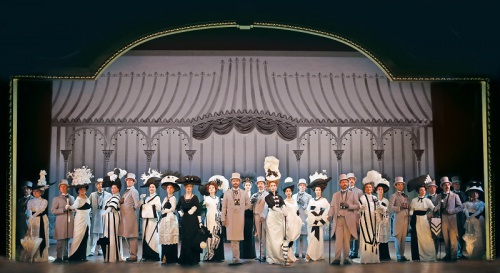
The young Andrews was of course the star, opposite Rex Harrison, of the 1956 Broadway premiere of this musical by Lerner & Loewe, adapted from George Bernard Shaw’s play “Pygmalion” and Gabriel Pascal’s motion picture of the same name.
People might think that the huge success of the production is entirely attributable to audience nostalgia, but that’d be wrong. While certainly the lavish staging by Oliver Smith and costumes by Cecil Beaton, where recreated by John David Ridge, down to the finest detail (where two ladies at Ascot are seen wearing the same outfit). But it is in fact Andrews’ subtle direction of “the thinking person’s musical” that leads to the dramatic interactions giving new vitality to a stage favourite.

But to my mind, it is the acting performances by the central characters that carry the day.
Central to these is the part of Eliza Doolittle, played by Australia’s Anna O’Byrne, whose crystalline voice sounds uncannily like the Julie Andrews of yesteryear.

Charles Edwards as Professor Higgins is at a disadvantage in one respect at least. His scurrilously patronising remarks – calling Eliza “a cabbage-leaf” is the kindest of them – are now largely unacceptable to an audience. His easy, flippant condescension, although funny when he hits the mark, reveals a man who is out of touch and in that sense no more a man than the lovesick Freddy Eynsford-Hill, (sung beautifully by tenor Joel Parnis) whom he scorns.
The controversial last seconds of “My Fair Lady” are almost but not quite destroyed when Edwards/Higgins inclines his hat over his eyes in a gesture of complacency.

This places the burden of humanity on Eliza and the main supporting characters, Tony Llewellyn-Jones as the kind but blustering Colonel Pickering and Robyn Nevin as Mrs Higgins, refined but sharp and worldly. The two actors help round out the world and character of Higgins.
As the amoral dustman/philosopher Alfred P Doolittle, Reg Livermore gives a joyous, scintillating performance, one of his very finest, even again as he rages against middle-class morality.
For even as the audience taps its toes through this handsome, lavish production, and especially gasp at the visual beauty of the Ascot scene, there is no escaping the underlying message proclaiming the bankruptcy of the British class system.
Julie Andrews, the musical directors, the choreographer, the designers and the whole cast clearly understand what underlies this perennial work.
News all day, every day at CityNews.com.au.
Who can be trusted?
In a world of spin and confusion, there’s never been a more important time to support independent journalism in Canberra.
If you trust our work online and want to enforce the power of independent voices, I invite you to make a small contribution.
Every dollar of support is invested back into our journalism to help keep citynews.com.au strong and free.
Thank you,
Ian Meikle, editor



Leave a Reply