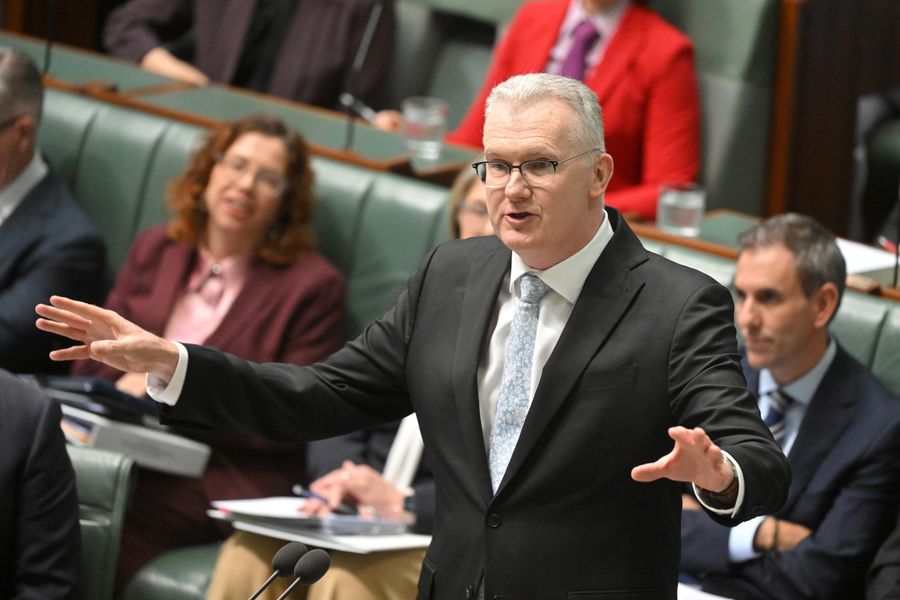
Home Affairs Minister Tony Burke’s cancelled his speech on migration that had been scheduled for delivery at the National Press Club on Thursday. Mick Tsikas/AAP PHOTOS
Tony Burke’s delayed migration speech has exposed just how politically and economically difficult it is for the Albanese government to overhaul Australia’s migration system, writes political columnist MICHELLE GRATTAN
Home Affairs Minister Tony Burke’s cancelling of his big speech on migration that had been scheduled for delivery at the National Press Club on Thursday was embarrassing but also revealing.
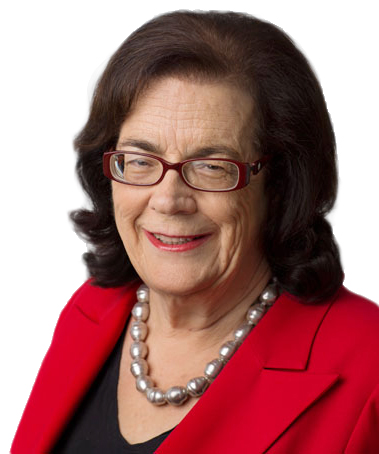
Michelle Grattan.
Obviously, Burke was unable to finish the work on time. He didn’t want to deliver a speech with glaring holes that had to be filled later. Reportedly, there were arguments when the policy outline was discussed by cabinet ministers on Monday.
One thing the delay tells us is just how hard it is to put together a good migration policy. Remember, the government commissioned an expert review of migration, led by former senior bureaucrat Martin Parkinson, undertaken soon after it won office. It was concluded in early 2023. Yet that blueprint was not effectively implemented by then home affairs minister Clare O’Neil and then immigration minister Andrew Giles.
What this week’s toing and froing also signals is that the government knows making more drastic changes to immigration to bring it under control is now a strong political imperative.
For some time, Labor could push back against the Coalition over immigration – the opposition has only partially released its own policy – and attack One Nation’s ultra hard line. But those tactics only divert attention for so long.
The government’s medium term objective is to reduce the Net Overseas Migration (NOM) number to an annual 225,000, way below the present level of around 300,000. The NOM is “the net gain or loss of population through international migration to and from Australia”. (The NOM has its technical limitations as a measure, but that’s another story.)
Net overseas migration, for years ending 30 June
a) Estimate for 2024–25, from ABS National, state and territory population, September 2025. Budget Paper No. 3
Particularly given Labor’s increasing concern that One Nation could erode its vote, it has to match the NOM projections it has set out in the budget, while doing it in a way that meets the reasonable needs of central stakeholders as well as those of the economy generally.
Government sources stress the NOM projections are Treasury forecasts based on current settings. (It is notable that past forecasts have been greatly exceeded.) They say the Burke overhaul is not about new cuts to the budget’s NOM. But it is about re-tuning the system with the aim of delivering those projections.
According to budget figures, for the financial year just ended, 2025-26, the NOM was estimated to be 295,000. The projected number for 2026-27 is 245,000. For the 2025 calendar year, the NOM was 301,000.
The overall NOM number is a centre of public attention but the program is replete with problems and challenges. And cuts will in some cases bring negative consequences.
We are getting fewer skilled migrants than ideally we require, especially for the construction sector. Those we do get are not used most effectively because, in part, of bottlenecks in having qualifications recognised in an easy and timely way. Parkinson has recently urged this qualifications issue be addressed urgently.
Unskilled migrants are needed for the labour shortages in the care economy, especially in aged care, so cuts that reduce these numbers will eat into a vital workforce.
The overseas student intake has already been pared back but further reductions would need to take into account the needs of the higher education sector and also the fact that international education is one of Australia’s major exports.
Horticulture, agriculture and other rural industries need temporary imported labour, so curbs here, for example to limit the number of backpackers, can mean not enough workers to pick the fruit. Backpackers are also a staple for the tourist industry. On another front, an ABC Four Corners program this week highlighted abuses in the treatment of some temporary migrants under the Pacific Australia Labour Mobility (PALM) program. The government says it has spent a lot of money to protect such workers but obviously more action is required.
One way of helping reduce the migration number is delaying family reunions, but this leads to distressingly long waits. There is already a huge backlog of spouse applications. (The Migration Act actually prohibits capping of spouse and dependent child visas.)
Abul Rizvi, immigration expert and former government official, says
The three key questions Burke needs to be able to answer are:
Why is 225,000 the right long-term NOM target when he said last year that there was no magic number’ and that long-term migration planning would restrict the government’s flexibility?
How can we be sure the changes the government is now proposing will be sufficient to get net migration sustainably down to 225,000?
What are the consequences of the proposed changes in terms of both impact on various industries and communities?
Rizvi also points out that reducing net immigration “in any sensible way” has significant lags in implementation, impact and publication of outcomes. “The government has left things very late.”
Burke’s office says his speech is expected to be rescheduled in the next fortnight. Apart from anything else, this will give the prime minister, presently on holidays, time for a careful look at the final version.
Let’s not miss the most glaring bit of information about immigration and housing that has now been made more apparent. We were led to believe that demand based on peoples need to live somewhere is driving the housing crisis with demand outstripping supply. Reordering the people in the demand queue, aka the budget changes, should have just changed who was buying with owner occupiers getting a leveler playing field. What we have actually seen is the demand queue has shrunk and the sky is falling according to anyone in the property investment sector. How can this be if immigration is driving demand. The answer includes what no one seems to want to admit. The housing crisis is not driven by excessive immigration but the demand generated by the ability for some to make a lot of money investing in the sector.
That doesn’t make the job any easier for the government given how poorly informed most people seem to be and the lack of any decent critical analysis in the media. Hence the challenge of delivering policy in an environment of scare campaigns rather than reality.
Also, if we really want to fix the proportion of younger owners in the market we are only going to get there if property investors start leaving. The longer they hang on the further house prices will need to drop so thank all those property investors if your upset about your house price going down.
Another also for anyone with a social conscience and concern about our female DV victims. A sad reality is many people start life in a happy marriage with kids and things fall apart as the kids get older and other stresses grow. We have a significant problem that many people get stuck in these situations which are significantly complicated by lack of resources and the need to live someone. Do some research on the number of older now single ladies stuck with nowhere decent to live or sticking in a bad situation because the fear of nowhere to live. We want a situation where families as they grow end up owning their homes to safe guard their futures. If the family owns it home and things fall apart then one average free standing home should be able to be sold to buy at least 2 units and there is always that security facing people caught in these situations. If the family can only rent all it’s life or only buy a unit and semi detached thing then that is putting extra pressure on people caught in bad domestic situations. Property investors by being allowed to invest in residential homes are making the scenario worse. Next time your debating about just how fancy a car a property investor can buy think about those ladies caught in a bad situation believing they are unable to leave because where else could they live. Housing security and availability is also about peoples safety and is not an area where the rich should be able to make money if there is any chance that investment provides barriers to vulnerable people finding somewhere to live. That includes putting up rents.
Six weeks after aborting his first attempt, Tony Burke has finally unveiled Labor’s migration overhaul – only to leave the government vulnerable from both sides of the debate, writes political columnist MICHELLE GRATTAN.
"Although politics is often framed in the news as agree or disagree, the tactic used most regularly is delay. The Labor government is the master of delay, and then one further step to shelve ideas or promises," writes MICHAEL MOORE.
"Going for three or more election wins is difficult. Very, very few can maintain that level of resonance across an entire nation of voters in a compulsory voting system for anyone aged over 18," writes political columnist ANDREW HUGHES.





Leave a Reply