Music / Floral Chorals in the Spring Salon, Limestone Consort. At Grainger Gallery, October 19. Reviewed by ROB KENNEDY.
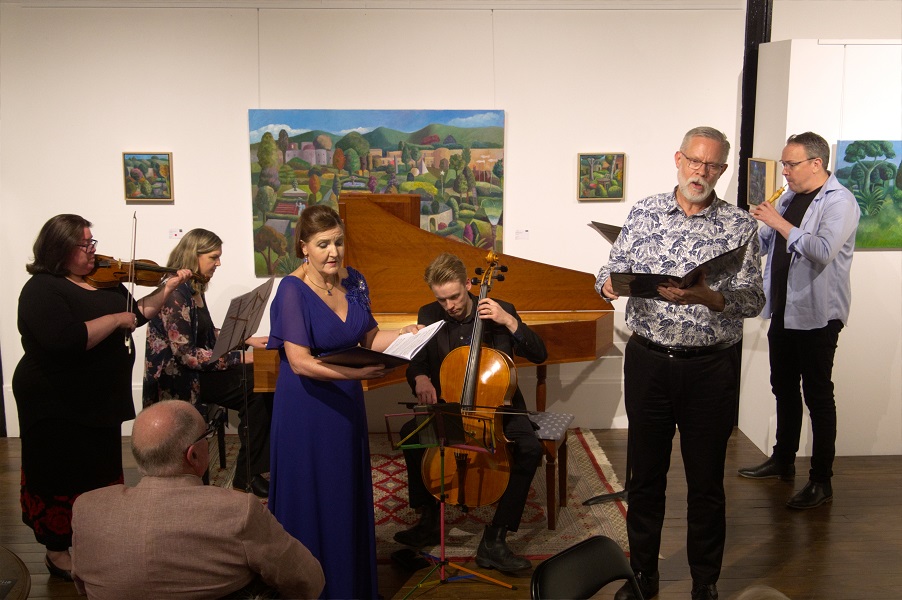
Partnering with Floriade About Town, the Grainger Gallery held a concert by Limestone Consort set amongst the imagined gardens of Andrew Antoniou’s The Garden, A Place Beyond Exhibition.
The concert featured Greta Claringbould, soprano; Andrew Fysh, bass; Lauren Davis, violin; Gabriel Fromhyr, cello; Aaron Reichelt, oboe and Ariana Odermatt, harpsichord.
Did the paintings melt into the music or the other way around?
Whatever the result, this concert was a breath of fresh air heralding in this spring season. The program included floral and nature-inspired baroque works by composers from Germany, Italy, and France.
Beginning with German-born Johann Christoph Pepusch (1667-1752), his work titled The Spring. Pepusch, who spent most of his life in England, composed music that fitted the taste of the time, which was the Italian baroque style.
The balance in this light and delicate work was like a conversation between the four voices of soprano, violin, cello, and harpsichord.
Then the French composer François Couperin (1668-1733) with his work La Paix du Parnasse from L’apatheose de Lully. This instrumental piece, which is just a small section of a much larger work, was melody driven by the oboe and violin and sometimes the cello. Odermatt’s harpsichord filled in the much-required continuo framework of the structure.
The quartet of players performed its sometimes complex nature with a natural flow and subtle lilt.
Sitting so close to the players in this intimate setting, a listener gets to hear every sound the instruments make, which fascinated.
Next, the Italian composer Alessandro Scarlatti (1660-1725) with his Sotto l’ombra d’un faggio. Lost, unrequited and found love are constant themes in many baroque works, and this one for bass voice and continuo is a profound piece with a splendid naturalness.
It was a gentle work that suggested a pastoral setting.
Then, a Trio Sonata in C minor by the Italian composer Antonio Brescianello (1690-1758). Following a simple theme, the first slow section stepped along until the second fast movement added colour and pace.
Not a repeat of the first section, the third showed greater depth and warmth. The fourth movement had much more promising musical material. The quartet concentrated more, as it was required, and it contained delicate touches, as did the playing.
And finally, another work by Alessandro Scarlatti, his song for bass, soprano, violin, and continuo, Bel Dorino, amata Clori.
This love story between Dorino, the bass, who is a shepherd, and Clori, soprano, a nymph, has a simple conclusion. Love wins out in the end.
This delightful performance in this intimate setting, and especially hearing a work for soprano and bass, one of the few in the repertoire, made for an inviting evening on the first warm night of spring.
The night was made extra special with a warm welcome and food and wine from the two generous hosts, husband-and-wife duo Kacy and Richard Grainger.
News all day, every day at CityNews.com.au.
Who can be trusted?
In a world of spin and confusion, there’s never been a more important time to support independent journalism in Canberra.
If you trust our work online and want to enforce the power of independent voices, I invite you to make a small contribution.
Every dollar of support is invested back into our journalism to help keep citynews.com.au strong and free.
Thank you,
Ian Meikle, editor

Leave a Reply