“The wilfully ignorant and under-informed ACT government is unlikely to have the humility, agility or competence to develop a land-use transport strategy that contributes to the effective management of the challenges facing the city,” writes planning columnist MIKE QUIRK.
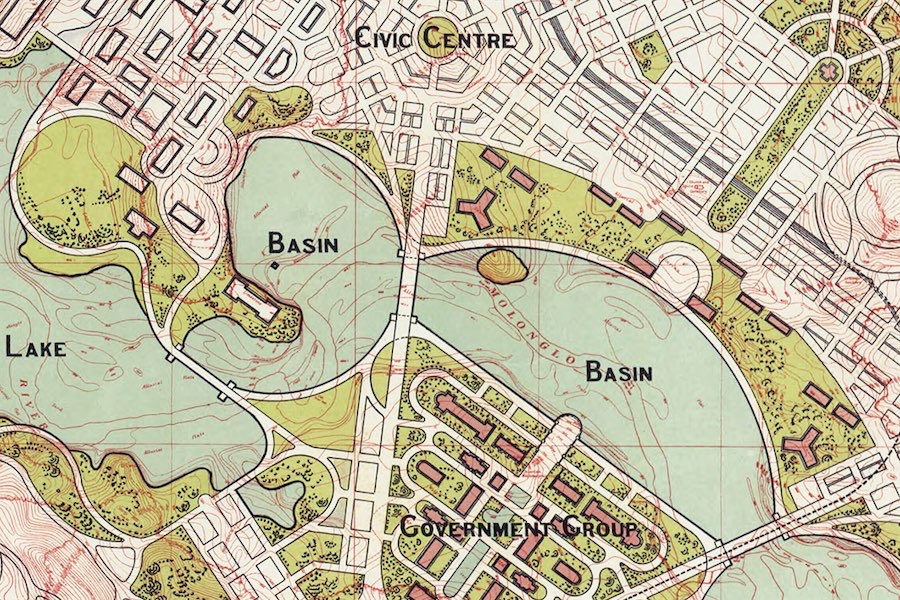
Canberra enjoys the legacy of two outstanding plans, the Griffins’ (1911-1918) plan and the National Capital Development Commission’s “Y-Plan”.

The Griffins’ plan, designed to guide Canberra’s growth to a population of 75,000, was an exemplary response to the forces shaping the development of cities in the early 20th century.
It successfully combined the City Beautiful movement’s emphasis on grand monumental structures with the Garden City movement’s focus on integrating the built environment with landscape and green spaces. It is an enduring legacy, most clearly illustrated in the Parliamentary Triangle.
A tramway network was a major design element in the plan. Operating in mixed traffic, it was to enable 90 per cent of the city’s population to live within 500 metres of a stop. Terrace houses and commercial activities were to line the main avenues with lower-density garden suburbs set back from the avenues.
The tramways were not developed, made unviable by increasing car use, the slow growth of Canberra (the city had only grown to 12,000 by 1939) and the decision in the early 1920s to replace the proposed terrace houses with individual cottages to better meet housing demand.
When the Griffins’ designed Canberra, car-use was minimal. In 1921 there were 45 people for every car in Australia. By 1947-48 the ratio had fallen to 7.8 people. By 2021 it was 1.3.
Transport technology is the dominant factor shaping the spatial structure of cities. Until the mid-19th century the structure of a city was determined by how far workers could walk.
The advent of railways led to suburban development in corridors linked economically and socially to the central city where retailing, employment and services remained concentrated.
Further suburbanisation was driven by the increasing use of the motor vehicle. Activities were increasingly dispersed to the suburbs and sub-centres developed.
Post World War II, Canberra had grown rapidly. By 1964 it had exceeded the Griffins’ plan design population and was forecast to exceed 100,000 by 1970.
In this context, after extensive assessment and influenced by British new-town planning, the Y-plan was adopted to guide growth up to a population of one million.
Key features included several new towns, each with centres (including substantial employment at a town centre) serving their respective populations and an extensive open space system. Movement was to be facilitated by freeways, peripheral parkways, an inter-town public transport route and a pathway network. Higher-density housing sites were identified, but their development was limited by the community’s preference for detached dwellings.
During the 1990s it became apparent the “Y-Plan” needed revision in response to changes including a reduced ability to disperse employment, the inability to develop land in NSW, improved awareness of environmental impacts and demographic changes resulting in underutilised infrastructure and an increased demand for higher-density housing.
Building on the quality environment created by the earlier plans, the focus of the new strategy was to (correctly) encourage development in established areas especially at centres and along major transport routes. Its commendable aims include the development of a compact, efficient, sustainable, resilient, liveable and accessible city.
How effectively the strategy is delivering these aims has not been assessed.
An inadequate knowledge of housing preferences has led to too many poorly designed and inappropriate redevelopments; and to an excessive restriction of greenfield land releases, which has contributed to house price increases and car-dependent development in surrounding NSW.
The greater reliance on privately initiated redevelopments complicates planning as it produces uncertainty about when and where development will occur.
Another deficiency has been the development of light rail. The assessment of Stage 1, Gungahlin to Civic, found bus rapid transport on its own right of way would provide the benefits of light rail at half the cost. For Stage 2, from Civic to Woden, BRT was not evaluated.
As well as disregarding cost-effective bus technology, the obsession with the high-cost light rail has resulted in a reduction in the funds available for increasing the electrification, frequency and coverage of the bus network; and a failure to consider other strategies that, in all likelihood, would have been more effective in reducing car use.
They include parking supply and charging, directing employment to locations well-served by public transport and additional transit lanes.
It is unsurprising, given the misplaced focus and the ongoing attraction of the car, that 75 per cent of trips in Canberra were undertaken by car in 2022.
The wilfully ignorant and under-informed ACT government is unlikely to have the humility, agility or competence to develop a land-use transport strategy that contributes to the effective management of the challenges facing the city.
The challenges include, how to respond to declining housing affordability, the poor quality of many redevelopments, changes in transport technology, increased working from home and more frequent extreme climatic events.
Can the Assembly persuade it to undertake the analysis necessary to address these challenges?
Mike Quirk is a former NCDC and ACT government planner.
News all day, every day at CityNews.com.au.
Who can be trusted?
In a world of spin and confusion, there’s never been a more important time to support independent journalism in Canberra.
If you trust our work online and want to enforce the power of independent voices, I invite you to make a small contribution.
Every dollar of support is invested back into our journalism to help keep citynews.com.au strong and free.
Thank you,
Ian Meikle, editor





Leave a Reply