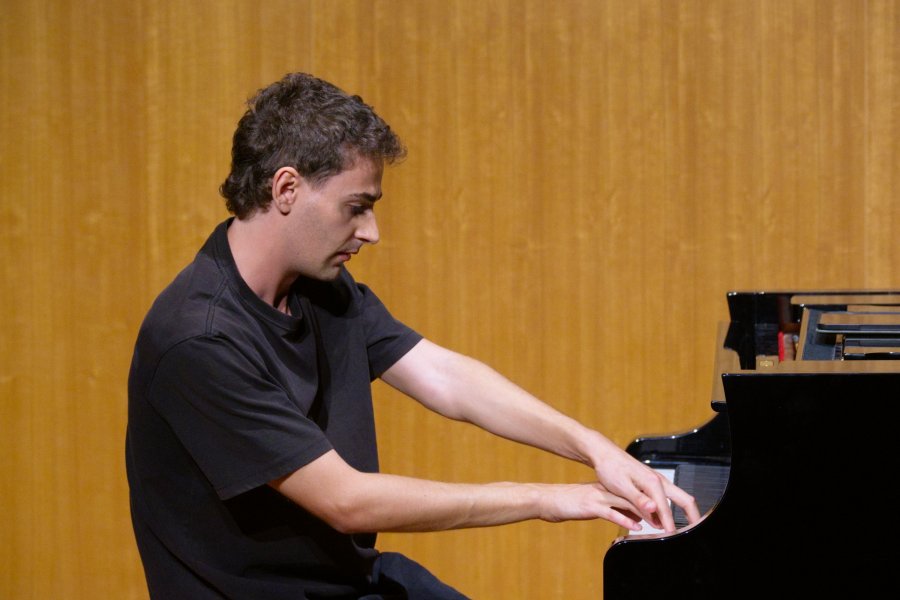
Music / Brahms and the Opposite of Brahms, Ronan Apcar, piano. At Wesley Music Centre, October 17. Reviewed by LEN POWER.
When beautifully tender piano pieces by Romantic composer, Johannes Brahms, were contrasted with modern works by Australian and American composers, the result was an exciting musical whiplash.
Performed non-stop by pianist Ronan Apcar, four of Brahms’ Fantasies alternated with three works that could not have been more different. Suddenly the Brahms works seemed even more delicate and fragile than usual, while the modern pieces became even more exciting, violent and explosive.
Apcar introduced the concert, giving us an insight into his enthusiasm for the music he would be playing. With his humorous and relaxed manner, he warned us to be ready for something out of the ordinary.
Beginning with the fourth Brahms Fantasy, adagio, his sensitive playing was immediately captivating, bringing out the beauty in Brahms’ music. At the gentle conclusion, he launched into American Leo Ornstein’s Suicide in an Airplane. This distinctive work, with its insistent sound of airplane engines, could not have been more different to the Brahms work. The contrast was fascinating and Apcar’s playing of this complex work was excellent.
Without a break, Apcar performed the fifth Brahms Fantasy, andante. After the Ornstein work, the gentleness and sentimentality seemed even more apparent.
Again, without a break, he then launched into Australian, Gerard Brophy’s Abraço. This stormy and exciting work sounded like five noisy, but thrilling dance parties going on at the same time. Apcar played it superbly.
Brahms’ Fantasy No. 6, andantino, was next. The emotion in the music was again delicately played. Immediately afterwards, there was the contrasting and wild Winnsboro Cotton Mill Blues by the American composer, Frederic Rzewski.
If the earlier modern pieces seemed unusually complex, nothing prepared you for this one. Ranging across the whole keyboard, this furious work was the most exciting of all.
The technique required to play it was astounding. At times, Apcar was playing passages with his whole forearm. When the blues section of the work was reached, Apcar sang the lyrics as well. It was an extraordinary performance.
The final work on the program was Brahms’ Fantasy No. 7, allegro. Again, this work was beautifully played and was such a contrast to the Rzewski before it.
Apcar finished the concert with an encore, The Spritely One by jazz musician Judy Bailey. The applause was explosive and sustained. Apcar richly deserved it for devising this daring program and performing it with so much skill.
News all day, every day at CityNews.com.au.
Who can be trusted?
In a world of spin and confusion, there’s never been a more important time to support independent journalism in Canberra.
If you trust our work online and want to enforce the power of independent voices, I invite you to make a small contribution.
Every dollar of support is invested back into our journalism to help keep citynews.com.au strong and free.
Thank you,
Ian Meikle, editor



Leave a Reply