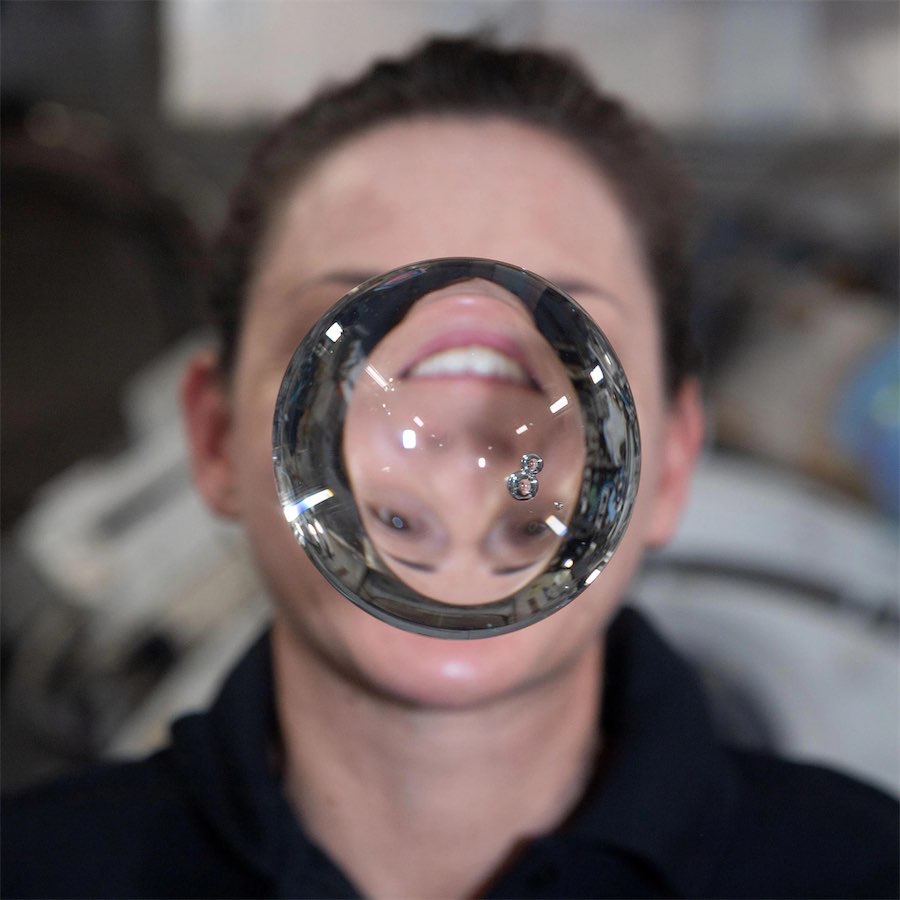
“After weeks or months in orbit, astronauts experience dramatic but short-lived symptoms. Many describe an overwhelming heaviness, as if their arms and legs are made of lead.” Whimsy columnist CLIVE WILLIAMS looks at weightlessness.
“If you look like your passport photo, you’re too ill to travel,” –Will Kommen
You’ve probably seen footage of astronauts returned from space being helped out of their capsules and then carried away on stretchers.

It can look alarming and naturally raises the question: what has living without gravity done to them?
The short answer is that weightlessness affects almost every system – but most effects are temporary, manageable, and increasingly well understood.
Back to gravity
After weeks or months in orbit, astronauts experience dramatic but short-lived symptoms. Many describe an overwhelming heaviness, as if their arms and legs are made of lead.
Dizziness and balance problems are common, making standing or walking difficult. Nausea, like severe motion sickness, often occurs, along with low blood pressure on standing, which can cause fainting. Muscle weakness can be striking – even holding up one’s head may be an effort.
Some astronauts need help walking for the first few days. A major contributor is the vestibular system in the inner ear, which adapts to weightlessness and must then re-learn gravity. Symptoms are worst in the first 24 to 72 hours and usually resolve almost completely within weeks.
Longer missions
Longer missions pose greater challenges. Muscle loss occurs rapidly in microgravity because muscles no longer support body weight. The legs, hips, and back are most affected.
To combat this, astronauts aboard the International Space Station exercise for about two hours every day using specialised resistance equipment. With rehabilitation after landing, most muscle strength returns.
Bone loss is the most serious long-term concern. Bone density decreases by roughly one to two per cent a month in key weight-bearing areas – like severe osteoporosis on Earth. Much of this loss can be recovered, but after long missions some bone loss may be permanent.
Cardiovascular changes also occur. In space, the heart works less hard and blood volume decreases. On return to Earth this can cause dizziness or fainting, but cardiovascular function usually recovers within weeks.
Vision and radiation
Researchers have identified Spaceflight-Associated Neuro-ocular Syndrome (SANS), in which some astronauts develop vision changes and increased pressure inside the skull. While many symptoms improve, some vision changes may persist, making this an active area of research.
The immune system also changes temporarily in space, and exposure to cosmic radiation slightly increases lifetime cancer risk. For space station missions this risk is considered acceptable, but it remains a serious concern for deep-space travel.
Life without weight
Despite the downsides, most astronauts enjoy weightlessness. Movement feels effortless, joints are unloaded, and chronic pain from old injuries often disappears. The real problems come not from daily life in microgravity, but from long exposure and the return to gravity.
The Mars challenge
Living on the space station rarely causes severe permanent disability, but risks increase with mission length. This becomes critical when considering Mars.
A typical human Mars mission would involve six to nine months travelling each way, with a long stay of several months to a year while waiting for Earth to realign. Mars gravity is only about 38 per cent of Earth’s – better than zero, but likely not enough to fully protect the body.
For this reason, future missions will almost certainly need artificial gravity during long journeys. The most practical method is through rotation: a spacecraft spins, and centrifugal force mimics gravity. Even partial gravity may be enough to protect bones, muscles and the heart.
Looking ahead
Artificial gravity hasn’t yet been built because rotating structures are complex and difficult to launch. The International Space Station was designed before many long-term risks were fully understood.
As humans venture further from Earth, we’re learning that gravity may be one of the most important life-support systems of all.
On a lighter note (no pun intended): If you saw a space man what would you do? Park in it, man.
And on a travel note: A friend was on a train travelling from rural West Ruislip to London’s Cockfosters. As the train came into the station it lurched as the brakes jammed for a moment and everyone in the carriage was thrown about.
Grabbing whatever they could, some passengers were thrown to the floor, others fell on to other people; women screamed, men shouted and some swore. It was a real confusion of bodies and luggage.
However, this being England, everyone was soon busy apologising to everyone else and asking whether they were all right, when the brakes released again. The train went strangely silent as it glided slowly for the last few feet into the darkened station, where the lights had apparently failed. A woman’s plaintive voice broke the silence.
“I can’t see,” she said. “Is this Cockfosters?”
A man’s cultured voice immediately replied: “No madam, it’s mine!”
Clive Williams is a Canberra columnist
News all day, every day at CityNews.com.au.
Who can be trusted?
In a world of spin and confusion, there’s never been a more important time to support independent journalism in Canberra.
If you trust our work online and want to enforce the power of independent voices, I invite you to make a small contribution.
Every dollar of support is invested back into our journalism to help keep citynews.com.au strong and free.
Thank you,
Ian Meikle, editor



Leave a Reply