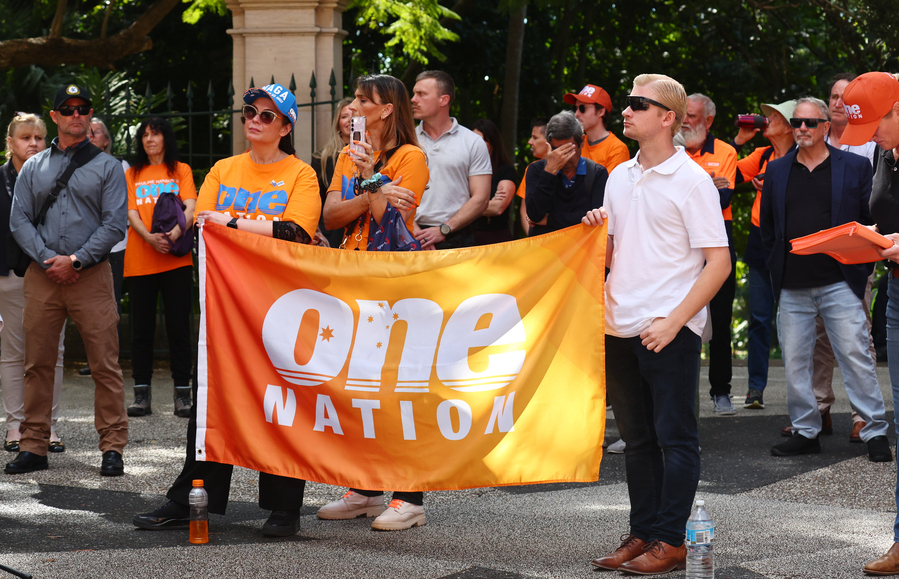
The “Howard battlers” and “Tony’s tradies” have become Pauline Hanson’s political heartland. Jason O’Brien/AAP PHOTOS
The “Howard battlers” and “Tony’s tradies” have become Pauline Hanson’s political heartland, leaving the major parties scrambling to win them back, writes political columnist MICHELLE GRATTAN
He is in his late fifties and lives outside a capital city. He owns his home — most often outright — and he still gets up and goes to work. He did a trade or a TAFE diploma rather than a degree, speaks only English at home, and calls his background Australian.
This is not a portrait of the fringe. It is a portrait of the part of Australia that used to be called the mainstream.
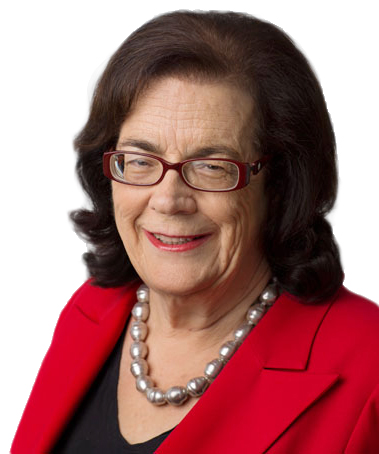
Michelle Grattan.
This was once a depiction of the “Howard battlers”, later “Tony’s tradies”. Now it’s Pauline Hanson who has a grip on many of these people, with who they are and what they think documented in an in-depth survey of more than 1000 One Nation voters.
For the major parties, especially the Liberals and Nationals but increasingly Labor too, these One Nation supporters are the wolves in the woods, dangerous and potentially lethal in coming contests for seats.
In the wake of last weekend’s Western Australian state byelection (lost by Labor to One Nation) and the May federal Farrer byelection (a One Nation rout of the Liberals), and with the Victorian and New South Wales elections looming, the “parties of government” know they must find ways to counter this insurgency of electoral disillusionment. That’s assuming it can be countered.
Key to the struggle ahead is understanding the identity of these rebels against the “system”.
The research is from former Labor pollster John Utting and former Labor adviser Bruce Hawker. Done in August, it gives a comprehensive picture of the demographics and views of this cohort.
The report concludes: “This is no longer a conventional protest vote, it has become considerably more entrenched”.
Utting told The Conversation on Friday: “It would be foolish to underestimate One Nation voters’ degree of alienation from the existing political system and traditional parties – and the potential for them to really restructure how politics is done in this country”.
Unsurprisingly, the poll found these voters are reacting to two big issues above all others – immigration and the cost of living, and the failure, as they see it, of major parties to deal with them.
“One Nation’s rise is as much a story of Liberal failure as of One Nation success,” the report says. “Immigration and the cost of living created the conditions. Labor is overwhelmingly rejected by these voters, and the Liberals have not offered them a convincing alternative”.
The further from a capital the stronger the vote, the polling found. These voters are older than average, with more than six in ten men, while more than three quarters own their own home, and about six in ten are still working. They are overwhelmingly Anglo-Australian.
One Nation support is strongest in Queensland (the home of Pauline Hanson) and South Australia (where the party now has seven in the state parliament after performing well at this year’s election) and weakest in NSW and Victoria. In each of the latter two states, it was at 20 per cent in this poll.
“Tradies are the heartland of One Nation support,” the report says. In household incomes the One Nation voters are spread relatively evenly through the middle three of the five income quintiles – a range of between $60,000 and $195,000.
Two thirds (67 per cent) say their household is worse off than three or four years ago.
The single largest source of One Nation voters is former Coalition voters (38 per cent). Seven in ten present One Nation supporters voted for some other party at the 2025 federal election or didn’t vote at all. Only 17 per cent of them voted Labor.
Their degree of alienation is highlighted by 71 per cent agreeing with the proposition that most politicians look after themselves not the country.
More than nine in ten (91 per cent) think the country is on the wrong track, especially because of immigration and living standards.
This is much higher than in the general population, where the feeling the country is headed in the wrong direction is also widespread. An Essential poll published this week had about 58 per cent saying the country was headed in the wrong direction.
The One Nation voters’ biggest worry with immigration is the number of people coming in (42 per cent), followed by the pressure on housing and services (28 per cent) and concern about crime and safety (17 per cent). In results drawn from open-ended questions only 5 per cent mentioned Muslims and Islam specifically.
But asked their specific reason for wanting lower immigration, 57 per cent nominated immigration changing Australia’s culture and identity too much.
The report identified two strong narratives coming through in relation to immigration, represented by these individual quotes:
..“You can’t bring in that many people and not build the houses.”
..“You walk through parts of the city and it doesn’t feel like the same place.”
A little under half (45 per cent) say they support One Nation mainly because of what the party stands for, while about a third (34 per cent) say they support it mainly because they feel the other parties have let them down. One in five says they support it mainly because of Pauline Hanson.
The view among “low commitment” One Nation voters is they have been let down by the major parties.
The votes of more than half of One Nation voters (52 per cent) are locked in, but many are less attached – four in ten have come to support the party only in the last year.
Asked to rank major parties and major figures, One Nation and Pauline Hanson rate top. They are followed by Ben Roberts-Smith, the Victoria Cross winner who is facing changes of war crimes. He has been strongly backed by Hanson. Roberts-Smith rates slightly above Barnaby Joyce, who defected to One Nation from the Nationals.
The One Nation voters were overwhelmingly opposed to the Labor government and Prime Minister Anthony Albanese. More than seven in ten said Albanese said one thing and did another.
Asked what Labor would have to do at get their interest. two thirds said cut immigration.
They are not much impressed with Angus Taylor, although more than a quarter say they could return to the Liberals under the right circumstances, such as cutting immigration.
Despite the major parties attacking One Nation for lacking policies or deliverable policies, 87 per cent think One Nation has clear workable plans to deliver what it promises. Half think One Nation can win government in its own right.
Tobacco wars
The Coalition and One Nation are squabbling over their respective policies to cut excise on tobacco in an effort to counter the tobacco crime wars which have seen many shops set on fire. One Nation got its policy out first, advocating a 75 per cent cut. This week the Coalition released its policy, urging an 80 per cent cut. On Friday, Taylor attacked One Nation’s plan as not properly costed.
Meanwhile, One Nation is running into some problems with its Victorian candidates. It is accused of misrepresenting the qualifications of one candidate, while another, Ben Lucas, who is running for Narracan in West Gippsland, pleaded guilty on Friday to operating a category-one aquatic facility without registering it with the shire council.
The bit you stepped around was also the influence of the Voice referendum on this. (Don’t shoot the messenger on this as I’m not giving an opinion on its merits). In a time of rising cost of living and house prices everyone is very sensitive to anyone appearing to game the system to get hand outs from the tax payer. Every time a group stands up and says, we expect to be treated preferentially for merely existing and you owe us will never go down well as times get harder. Every time they do this One Nation gets a few more voters. Like it or not, ignore it or deny it at your own peril. Pauline has her views on this and sometimes the best approach is to make yourself a small target so you aren’t providing support for the wrong people.
One Nation has a seat at the table because the major parties made that seat for them.
The challenge is, the recent government moves on housing affordability is directly focused at people like tradies, hard working individuals wanting to get themselves and their kids ahead. However, it is too little too late so hard to sell. For the last ten years the way to get ahead was real estate, flogging the dying horse in an unsustainable environment. Now that has been taken away and people caught in that are struggling and those who were relying on it now question how they will get ahead.
It was noticeable on the Sunday ABC Jim Henson show, Insiders, how poorly they addressed the issue. More worried about whether Labor was going to feel the pain on doing the right thing and having to go back as oppose to addressing the actual issue the government are trying to fix. They should have focused on just released figures showing housing affordability is at its lowest and whether the government has done enough. Instead they playing into the childish politics of failure and basically provided more support for the One Nation. Why doesn’t someone focus on One Nation and how they plan to fix housing affordability. The big picture. (BTW income splitting apart for working against young single people also puts undue pressure on relationships which can only drive up DV).
Where is the discussion on how to address housing affordability taking into account we cannot build our way out of it if houses are too expensive to build, as indicated by builders going bust. How does a lemonade stand go bust on a hot day? Housing affordability is the affordability of people needing to owner occupy, not property investors. Where’s the discussion about, we’ve had the budget changes and it’s still getting worse. We don’t need to roll those changes back but go further. Why are we grand fathering existing investment properties and making it viable to leave houses empty? Getting those houses in the right hands can only help because it’s a far quicker way to increase supply to the right people. What about to avoid house prices dropping, the tax payer support of investors moves to owner occupiers with loans giving them some relief. The tax payer is going to have to put money towards this so why not provide tax breaks for people already stuck in the system trying to buy their own house. If these people fail then the tax payer will be paying anyway. Give them support to own their own house and get out of the system. Much better use of tax payer money than anything going towards property investment. Remember, prospective owner occupiers paying rent is just money thrown down the drain. It hurts them and the tax payer. Get that money working for them and the country into paying off a home.
We’ve got into this weird existence of blaming interests rates on housing affordability so much so that some property guy said that it was the three interest rate rises this year that and a big cause of the problem. That’s only 0.75%. Buying a house is a longer term thing and if interest rates varying by only 0.75% is a major problem them something else is severely broken. The interest rates have such an effect because housing is too expensive, driven up by the real estate industry et al making money out of a basic need. It was like the devil pointing at the undertaker and saying they are responsible for all the death.
The housing affordability crisis is driven by people making money out of housing. 400% in 20 years. Not interest rates. Why do journalists let people make such statements without questioning them on the spot? If your dumb to believe the interest rate pitch then at the start of the 20 years, back when houses were more affordable, rates where much higher. So, logically it must be the low interest rates causing the problem so they should be higher.
While we’re discussing muppets, do you see the opposition health spokesperson making the interviewer look like a fool regarding cutting excises? The opposition believes that cutting the price won’t drive more take up because we have other disincentives. The problem with this, as any advertiser knows, the impact of packaging etc is most effective the first time (or only works once). Once it’s there and things pick up again you need a new disincentive. Relying on anything existing to suddenly work better to pick up a failure on another deterrent is just asking to be made to look stupid. Ask the opposition what their new deterrent is or what part of Medicare they’ll need to remove to pay for all the extra money required to treat the increase in smoking.
What began as a promising political opportunity has become a migration minefield for Angus Taylor, caught between One Nation’s tougher stance and business concerns, writes political columnist MICHELLE GRATTAN.



Leave a Reply