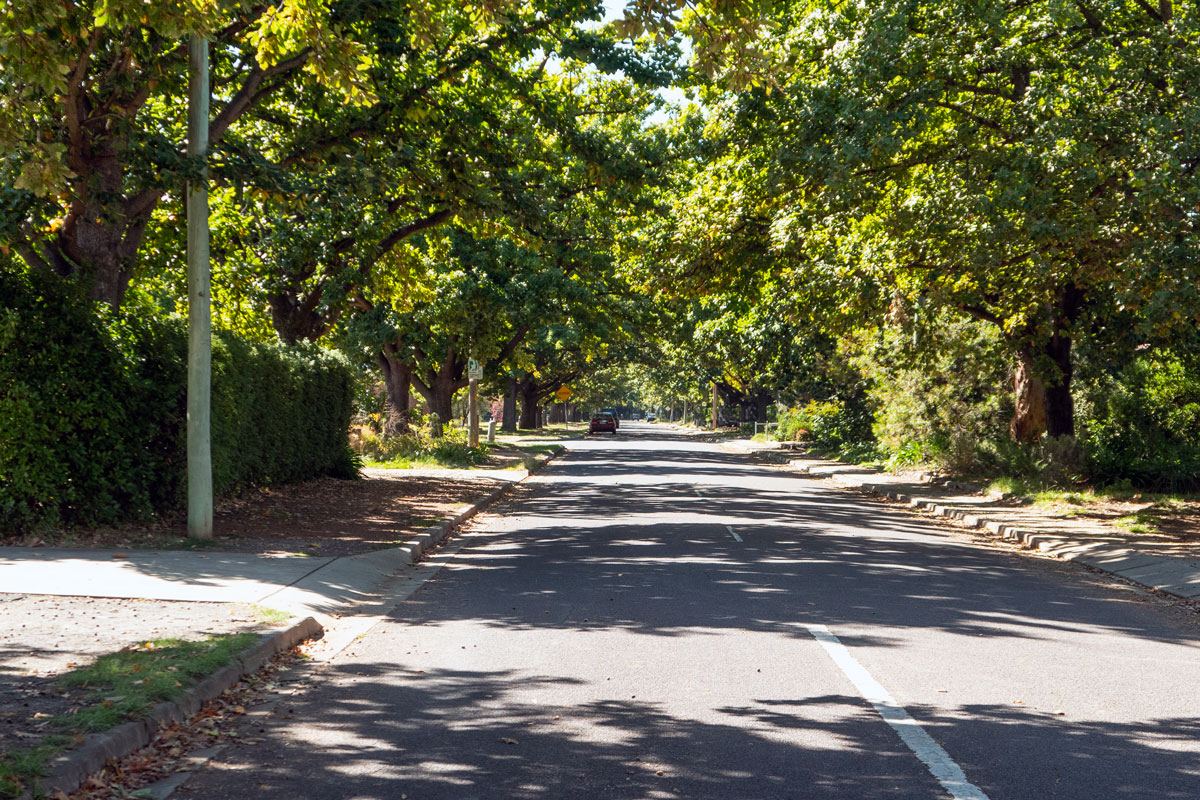
Why is it that instead of being proud to live in the best city environment in the world, our leaders wish to copy other cities that have been such failures, cities that are struggling to get some of the advantages that we have here in Canberra? Photo: Paul Costigan
“A myriad of failures in planning have been made since self-government. Planning Minister Chris Steel is about to preside over the most significant of the failures,” says political columnist MICHAEL MOORE, despairing at the lazy planning that’s being facilitated by a complacent government.
The planned city of Canberra, the source of such pride, is now at risk.
Michael Moore.
The careful planning to facilitate families and to build a bush capital is being strategically bombed by current government policies, to use the words of former chief planner Peter Harrison.
Lazy planning is being facilitated by a complacent government. Planning laws have changed, and in this budget our leasehold system and the environment are being undermined.
Sugar coating the process has already begun by employing standard propaganda techniques – start with a phrase that has some truth to it – and then drive it home. In the US, Donald Trump has used “Make America Great Again”. In the ACT the planning minister and his acolytes constantly use the phrase “the missing middle”.
They argue the missing middle must urgently be addressed. Step one was to relax the planning laws to allow redevelopment of single-dwelling blocks across the ACT to make Canberra as dense as unplanned cities.
The budget has been used to encourage development of current single housing blocks to destroy backyards. The developers will love it. The change of lease purpose will allow 50 per cent back to the developer rather than the current full value of the change of purpose.
The Canberra leasehold system is set up to stop speculation on land through the change of use. The profit coming from a different use of the land belongs with the people rather than the developer. For example, the value of land for church purposes is very low. If the church is to be bulldozed and replaced with a high-rise tower, the value of the land is very high.
In this case the profits from building the units belong with the developer. However, the profits from the different use of the land in a planned city that uses a leasehold system belong with the community.
It is common in other cities to see single dwellings squeezed between six packs of flats. Flats! Flats? Wrong language for the missing middle, they will be referred to as town houses to create the impression that they will have little or no impact on neighbours.
A recent article in The Conversation by Dr Mohammad Rahman from the University of Melbourne argued “trees and greenery can cool cities by as much as 18°C”. He did add that they must be the right sort of trees with a particular focus on “layered vegetation”.
This government pretends to address climate change. Dr Rahman argues that “cities trap heat. Roads, buildings and asphalt absorb solar energy during the day and slowly release it back into the air, especially at night. This ‘urban heat island’ effect, combined with climate change, is making heatwaves more intense and more dangerous in our cities”.
The great delight about flying home into Canberra is looking down at established suburbs and observing houses dotted between the trees. In other cities we see houses with a few trees dotted between them.
Just planting trees is not enough, “a ‘one-size fits all’ greening strategy can fail. A planting design that works well in Melbourne may behave very differently in Hong Kong or Munich” according to Dr Rahman.
However, in a planned city such as Canberra, the presence of an abundance of trees, a strong canopy with the support of shrubs and ground cover reduces heat significantly. He measured radiant heat in Melbourne and cited the 18°C difference between well planted streets and those with no trees.
It is not hard to extrapolate the difference for Canberra when single-dwelling houses are bulldozed and replaced with much more intense development. Where there is no room for the same canopy and layered planting, there will be an increase in radiant heat.
A myriad of failures in planning have been made since self-government. Planning Minister Chris Steel is about to preside over the most significant of the failures.
The city will move to the sort of mixed hotch-blotch that is seen in so many other places. Rather than expanding options, there will be much less choice in the type of dwelling, and environment in which to live.
Why is it that instead of being proud to live in the best city environment in the world, our leaders wish to copy other cities that have been such failures, cities that are struggling to get some of the advantages that we have here in Canberra?
Michael Moore is a former member of the ACT Legislative Assembly and an independent minister for health. He has been a political columnist with “CityNews” since 2006.
Congratulations to Michael Moore for putting in writing the sentiments of many watching our elected government destroy the city and its greatest claim to fame world-wide, namely that of being a “Bush Capital”.
There is just one thing that needs to be added when discussing the government’s plans which are creating heat sinks both by its “Missing Middle” policy and high-rise, high density areas along the tram. That is, the government’s refusal to make available information on where in Canberra new constructions have increased urban heat during the last decade in spite of many requests, especially to the Greens when they were part of the administration.
In their accompanying article “Mapping surface urban heat in Canberra” the CSIRO authors describe the reason for publishing this map as follows:
“Certain people may be at greater risk of poor health from prolonged exposure to extreme temperatures, and this provides a challenge for urban planners and managers in Canberra to lower that risk by reducing urban heat in summer while maintaining protection against winter cold. The aim of this project was to map the spatial patterns of urban heat and to a lesser extent cold in the ACT, and the associated heat-related population vulnerabilities, building the evidence base that is required to inform ACT Government decision making on climate adaptation actions.”
One would have thought that our Planning Minister would have asked for a new version of this valuable “evidence base that is required to inform ACT Government decision making” provided by the CSIRO to gain an idea where an increase in heat has occurred before putting in place new planning legislation. Especially since the maps are relatively easy to produce as land surface temperatures are reliably recorded by thermal infrared sensors from earth-observation satellites. On the maps, these temperatures are shown with easily readable colour-coding, identifying urban areas where extreme heat is increasingly posing a risk to public health with dark red blotches.
Maybe that is the problem. One could come to the conclusion that the ACT planners would prefer for the public not to know where their effort at planning during the last 9 years is likely to have resulted in a substantial increase of these dark red blotches.
What began as a promising political opportunity has become a migration minefield for Angus Taylor, caught between One Nation’s tougher stance and business concerns, writes political columnist MICHELLE GRATTAN.



Leave a Reply