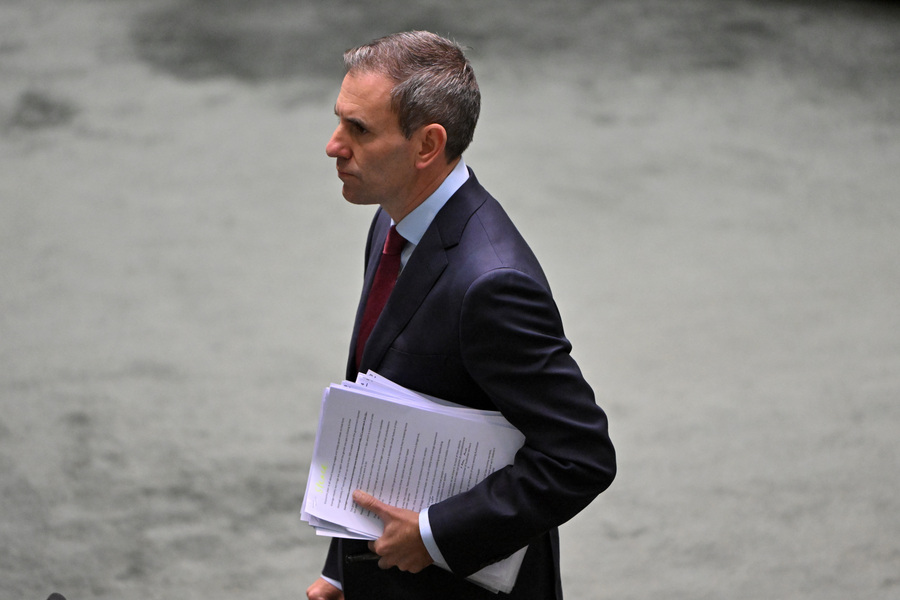
Treasurer Jim Chalmers looks to bolster Labor’s argument against One Nation’s ‘early superannuation’ proposal. Mick Tsikas/AAP PHOTOS
Jim Chalmers says the next election will be an “existential moment” for compulsory super, as Treasury projections strengthen Labor’s case against early access, writes political columnist MICHELLE GRATTAN
Treasurer Jim Chalmers on Wednesday will release projections from the government’s Intergenerational Report to bolster Labor’s argument against One Nation’s proposal to allow homebuyers and renters access to some of their superannuation.
Michelle Grattan.
Chalmers casts the next federal election as an “existential moment” for Australia’s compulsory superannuation scheme, which was a major Labor reform.
In the IGR, to be released on September 21, Treasury projects the number of Australians over age pension age will almost double to about nine million by 2066. But the share of this cohort receiving a pension or income support payment is projected to fall, from 66 per cent last year to 52 per cent by 2066.
Spending on age and service pensions is projected to decline from 2.3 per cent of GDP last year to 1.8 per cent in 2066.
The IGR, prepared by Treasury, maps out how economic and social changes are likely to unfold over the next four decades. There have been five previous reports, with the first in 2002.
In a speech to the Super Members Council, released ahead of delivery, Chalmers says superannuation “will be front and centre” of the report.
That’s because super is absolutely crucial to making the future work for us not against us.
It is one of the most important ways we will outperform the world in the decades to come.
There is no better or broader antidote to the serious intergenerational pressures we face together.
Chalmers says our superannuation scheme means “no other developed country will do a better job than Australia at taking pressure off the pension system, while boosting retirement incomes at the same time”
Spending on age and service pensions is projected to be nearly 10 per cent of GDP by 2060 in the United Kingdom, 8 per cent in Canada, 7 per cent in New Zealand, and 6 per cent in the United States.
“Total pension spending is expected to go up in most OECD countries, in Australia spending as a percentage of GDP will go down.”
“Pension spending as a share of the economy will be the lowest in the OECD but even as those costs moderate, retirees will have more economic security not less.”
Chalmers says superannuation makes the budget more sustainable in an ageing society.
The median retirement age balance will near $450,000 over the next decade. “That’s a big leap from a bit over $200,000 in the latest data – another considerable improvement on the $115,000 a decade earlier,” Chalmers says.
“And drawdowns from superannuation are projected to double to around 6 per cent by 2066.”
The $4 trillion super pool is “a key driver of the growth in foreign income inflows, supporting our gross national income,” Chalmers says.
“So while it’s boosting retirement incomes it’s helping to unlock investment here and abroad, reduce reliance on the pension, strengthen international relationships and deepen our capital markets.”
Chalmers says compulsory super, “with preservation at its core”, is facing its biggest threat since it began, intrduced by the Hawke-Keating governments.
The crazy announcement by One Nation and the supportive comments from parts of the Coalition have made this very clear.
They will end super as we know it and millions of workers will be poorer as a consequence.
The next election will be super’s existential moment.
It will help determine whether we make the most of our intergenerational advantages or trash them.
Whether workers are more secure in retirement or poorer.
Chalmers says the Council’s modelling showed a median full-time worker would see their retirement income cut by $25,000. A couple would be more than $50,000 worse off.
“Every dollar a twenty five year old withdraws now would mean they lose around $3 by the time they retire.”
He says One Nation and the Liberal and National parties “would put at risk the fiscal sustainability, higher living standards and stronger economy that the IGR shows will be supported by a strong and maturing super system”.
You could say this was madness on behalf of the ALP. They’ve already got a fight on their hands with the sensible changes to making housing more affordable. Now they are also fighting all those people who when asked, “why do you want to access some of the super now” with “because I want to own my own home when I retire”. There is no madness in that response yet the ALP is implying these people are mad.
The bottom line is trying to stop the rape of the housing sector by investors supported by the tax payer is not a budget killer. It has more pluses than negatives. Trying to fix the problem that more and more people are going to end up retiring without own their own home and having a bit more money in super is on no value, will hurt the budget because super is just as much for the government as for the people. Every $1 a 25 year old withdraws means $3 when they retire is a rubbish statement if they retire without owning their own home. A couple of years paying rent in retirement will blow any additional savings away. Add to that rent spent from 25-65 because they couldn’t get in a position to start buying a home and the $1 to $3 statement is just so stupid.
If the major parties don’t see this from the perspective of the people this affects then One Nation will own the space. In simple terms, we’ve had Super for the last 20 years as housing affordability has got significantly worse. The only change is the sacrifice rate has gone up. With that back drop, trying to convince people leaving it as it is will help fix anything will be like trying to argue with your dog about how much time it should be spending on its violin lessons.
For the benefit of all, why does one of the recognized financial whizzes outline in detail the exact impact allowing people to divert their super into paying off an owner occupied house will have. Throw in some sensible caps and guidelines and let the debate begin.
What began as a promising political opportunity has become a migration minefield for Angus Taylor, caught between One Nation’s tougher stance and business concerns, writes political columnist MICHELLE GRATTAN.



Leave a Reply