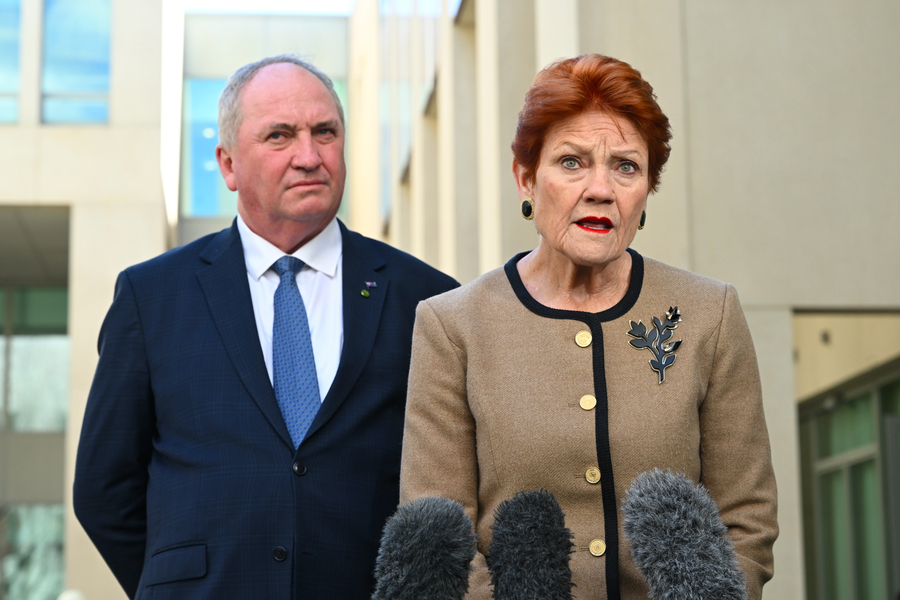
One Nation leader Pauline Hanson (right) insists the measure would be inflation-neutral, while treasury spokesman Barnaby Joyce (left) argues limited take-up would make any inflationary effect “undetectable”. AAP Image/Lukas Coch
Pauline Hanson’s super plan may be high on populism and low on economic support but it has once again left the Liberals scrambling to respond, writes political columnist MICHELLE GRATTAN
Pauline Hanson’s attention-grabbing policy to give mortgage holders and renters greater access to their super is high populism while being – according to its many critics – low economics and bad for people’s retirement.
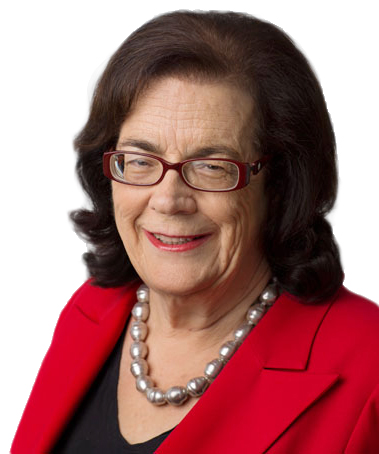
Michelle Grattan.
That said, one “teal” independent, Kate Chaney, says it’s worth examining. And Liberal maverick frontbencher Andrew Bragg doesn’t seem to be entirely writing off the idea either.
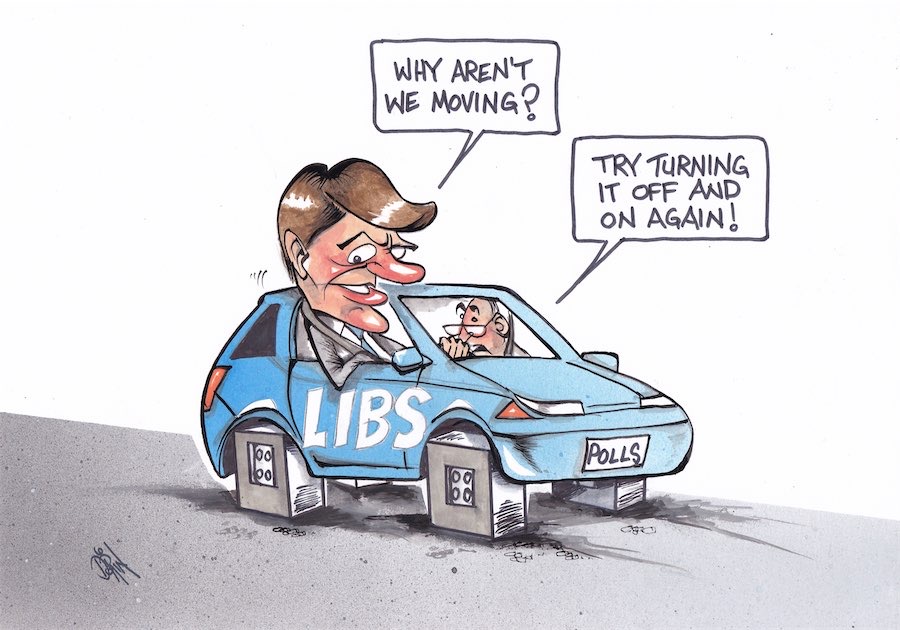
Once again, One Nation is out in front, leaving the Liberals in particular in its dust. The Coalition was gazumped on tobacco excise policy. Now the Liberals are having to argue why the Hanson prescription for helping people with their cost of living is flawed.
Under the Hanson proposal, renters and those with mortgages could choose to receive a quarter of their future superannuation contributions in their take-home pay for up to three years.
Employers would continue to pay the full current contribution, which is 12 per cent of wages.
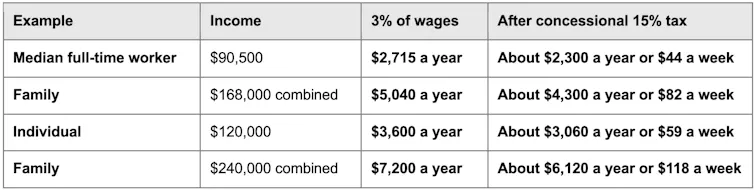
“If you take the boost, one quarter of this contribution will be paid directly to you by your super fund,” Hanson said in a statement. This money would receive the same concessional tax treatment as if it had stayed in the fund. “For most Australians, that means it will be taxed at 15 per cent rather than their higher personal income tax rate.”
Hanson says a full-time worker on $90,500 would receive about $2300 a year after tax ($44 a week).
Pauline Hanson’s proposed change to super access
One Nation Press Release
The policy would not apply to investment properties. Nor would it apply to past super contributions.
At present there is some provision for access to superannuation in cases of “severe financial hardship” but it is very limited.
Predictably the industry doesn’t like the Hanson idea. The Association of Superannuation Funds of Australia said, “This policy would push up inflation and make people poorer in retirement. It’s as simple as that.”
Hanson insists the measure would be neutral for inflation, although the party has not produced any modelling. One Nation’s treasury spokesman, Barnaby Joyce, argues only some people would opt to take out money, and the effect on inflation would be “undetectable”.
Politically, Kos Samaras, from the Redbridge Group, doesn’t believe the policy will be a winner, saying it’s “ill thought-out”.
He says the voters to whom it is pitched are more likely to have parents on the pension. They would view their super “as the only thing they’ve got that would have them living a different life to their parents”.
Treasurer Jim Chalmers described the policy as “a recipe to make Australian workers tens of thousands of dollars worse off in retirement”.
Opposition leader Angus Taylor said the policy left many unanswered questions, declaring “what we see with these policy announcements constantly is no detail, and the detail really matters”.
The Liberals themselves have unanswered questions when it comes to superannuation. They’ve previously proposed allowing first home buyers to dip into their super to help with a housing deposit but are not saying whether they’ll persist with that proposal.
Bragg told News24 the opposition presently has under review “the intersection of the retirement and housing policies”.
As to Hanson’s policy: “Look, anything that’s going to help Australians with their cost of living right now is going to be worth looking at,” he said. “But I make the point that it doesn’t address the long-term structural challenge here, which is that we see a doubling of retired renters over the next couple of decades. That’s a trend we want to kill because we want people to be in their own house when they are retired.”
Economist Richard Holden, from UNSW, says the One Nation policy is hard to assess without concrete details and a costing from the Parliamentary Budget Office. He said a thought bubble was better than having no thoughts but that did not add up to a proper policy.
Independent economist Chris Richardson tweeted that about two-thirds of Australians would be eligible for the Hanson policy.
“If everyone took that money, that’d be an extra $26 billion a year available to be spent. Much of that money would be spent on housing – as One Nation notes. But Australia doesn’t have a lack of money chasing our housing. What we have is a lack of housing.”
Chaney is open-minded, saying the One Nation idea deserves “further consideration”.
She references work by independent think tank the Grattan Institute.
In 2024 Grattan Institute’s Brendan Coates, told the Australian Financial Review Super and Wealth Summit: “There is now a really strong case for allowing early access – ideally, not just for housing, but to allow people some choice”.
“The best model is to basically allow people to cash out anything above about 8 to 9 per cent of wages each year at tax time, and have those withdrawals be added to their taxable income and taxed as wages.”
Coates maintained people were being forced to put away more money than they needed. “That’s the conclusion of Grattan’s work – retirees typically have a higher standard of living in retirement than they have working – and that remains true regardless of whether you’re looking at full-time workers, part-time workers, those that take career breaks.”
Coates is now in treasury. He was recruited to help beef up the department’s advice on housing.
Did anyone see the disastrous Joyce interview on ABC last night/? Talk about a train wreck. If you are going to attack One Nation then your target audience is people currently supporting or likely to support One Nation. Anyone who thinks trying to ambush Joyce like that is going to do anything but increase their support is misguided.
As for the numbers being quoted, let’s say pick being $50K worse off in retirement. What a pathetically stupid example. Tell that to someone who sees retirement 20 years away and wondering if house prices will go up another 400%. The number is just insulting. Tell that to anyone renting a house for their family and paying only $500/wk. That $50K is gone with NOTHING TO SHOW FOR IT it in just two years. You’re trying to argue with people struggling, wondering what they can afford something semi decent for their children, if their marriage will break under the strain, to worry abut what happens in their retirement for a miserly $50K. Bearing in mind, many have lived through property prices going up $50K while they have breakfast.
Barnaby may have been ambushed and not have numbers at hand but all those likely One Nation voters will have the numbers at hand of what it costs them now. Time for the ABC to rethink who’s running the 7:30 report.
Stepping in for the political analysts of this country, who seem to be a waste of space, let’s examine a few things. One of the interesting things about a system falling apart is things get exposed that those in power wanted to keep hidden. One of those is the way government increases taxes. By not indexing to inflation the government got a steady and required increase in taxes without everyone getting too upset. The LNP just did the stupid thing of highlighting this so now, if this is changed, we’re still going to need to steadily raise taxes but it will be played out as an election issue every time and we’ll be not better off.
The other one is Super. Super is there to get people off the pension. As it rolls in it’s not too obvious and people still have some access to the pension and mostly own their homes when they retire. This has now significantly changed with people living longer and many now not owning their own homes when they retire. Remove the assumption that most people will own their own home and Super just for savings no longer makes the sense it did. Having super stops you getting the pension and doesn’t help your ability to own a home by the time you retire. It is no longer fit for purpose as to be effective the two need to be linked. Where we are currently going people are going to start resenting the pension as its going to end up being for those smart enough not to work or find a way to transfer any super into home ownership, without being caught, so they can claim the pension. Your money is far better off in retirement parked in home ownership as it is not included in your pension assets.
The debate has to happen because property investors have raped the residential housing market. Running around claiming the sky is falling and telling people they don’t understand the economics of why they are struggling, and, that they should be focused on their retirement in the current environment, probably isn’t going to get us where we want. Unless of course we want all the people we don’t want in power, holding the balance of power and making decisions that do more harm than good.
Also, think about this. Everyone keeps saying we have a lack of housing. Do we really have a lack of housing or a lack of access to the current houses by the people who we want to owner occupy them. The elephant in the room is what would everything look like if we stripped out the property investors (and vacant property) the suitable properties and got them into the hands of owner occupies.
Apparently the government is about to release figures showing how well super is performing and an increase in average savings up to some measly figure like $400K (compare to housing prices).
Ask yourself this, when you retire and had say $600K (needs to be high for the next bit) would you prefer to have that in the house you live in (i.e owning it) or in cash and owning no home. Answer is pretty obvious so let’s hope those journalists and political analysts start asking the right questions
Let’s not forget that when you retire you ideally want to be owning your home with no strata arrangements covering it so you have control over your future costs. Maybe the government needs to start covering strata payments for retirees as we’re all being forced into tiny homes with shared infrastructure.
What began as a promising political opportunity has become a migration minefield for Angus Taylor, caught between One Nation’s tougher stance and business concerns, writes political columnist MICHELLE GRATTAN.



Leave a Reply