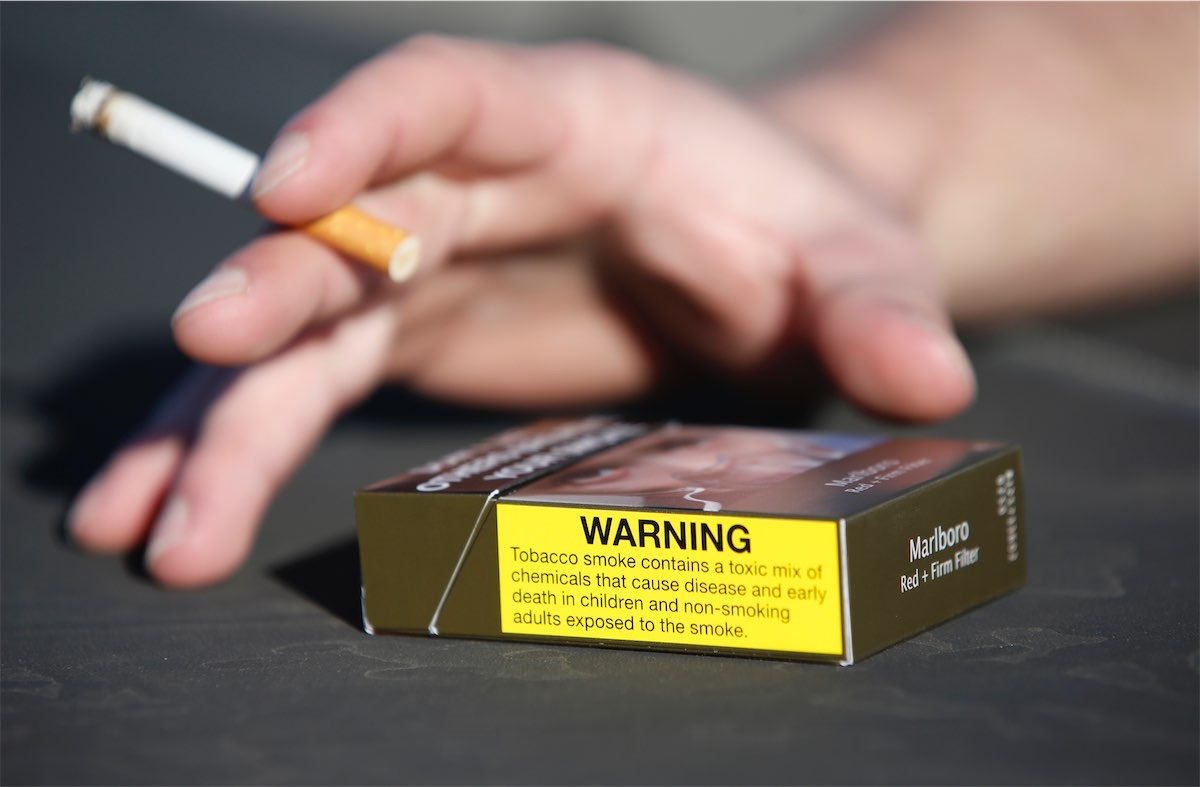
Australia has some of the world’s highest cigarette prices with half-a-pack a day costing about A$7000 to $12,000 per year at prices of around $38-66 a pack in the legal market. Regi Varghese/AAP PHOTOS
Almost one in five Australians who smoke report going without essentials because of the cost. CORAL GARTNER and ARA CHO explain why cheaper cigarettes aren’t necessarily the answer.
As cigarette prices have risen, so too has concern about the impact on low-income households. Critics argue tobacco taxes place an unfair burden on people with fewer resources, while contributing to a growing illicit market.
Some – including the Coalition and One Nation – have called for tobacco taxes to be slashed by 80 per cent or 75 per cent respectively, while others have argued for them to be abolished.
Making cigarettes cheaper may seem a logical fix. However, our study suggests it would risk making smoking-related poverty in Australia worse overall.
When smoking crowds out the essentials
A lesser known harm of smoking is what researchers call “smoking-induced deprivation”. This is when spending on cigarettes leaves people without enough money for food or other essentials, such as rent or electricity bills.
To examine this issue, we analysed data from 26,888 people who smoked at least monthly in Australia, England, Canada and the United States between 2016 and 2024.
In our new study, published in the journal Addiction today, we found the proportion of people who smoke who reported smoking-induced deprivation had increased in all four countries since 2016.
In 2024, almost one in five Australians who currently smoked cigarettes (18.3 per cent) reported experiencing smoking-induced deprivation. This was higher than in England (14.3 per cent), Canada (13.0 per cent) and the United States (10.4 per cent).
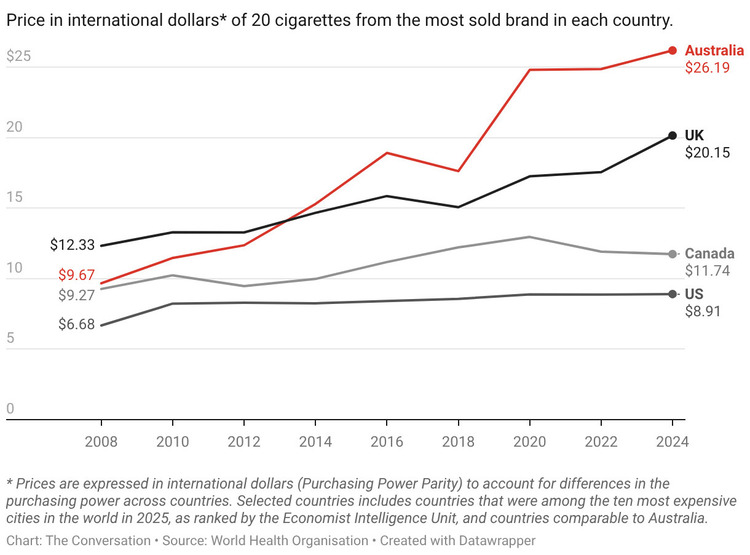
In Australia, cigarette prices in 2024 were 1.81 times the price they were 2016. Similarly, pack prices rose by a factor of 1.67 in England, 1.38 in Canada and 1.39 in the United States.
The price of a pack of cigarettes in Australia and selected countries
So our research findings suggest the cost of cigarettes – including tobacco taxes – is part of the story behind a rise in smoking-induced deprivation among people who smoke.
But there’s a bigger picture trend, which shows some better news.
Reducing overall smoking poverty
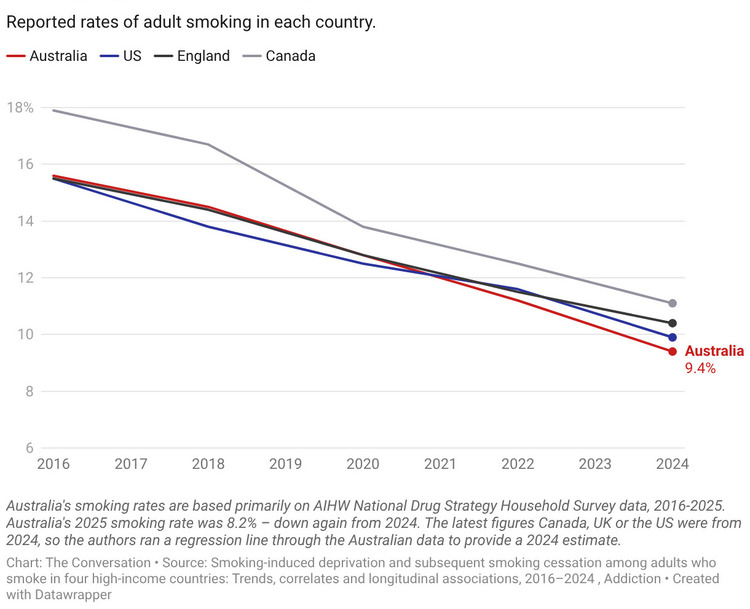
In 2016, 15.6 per cent of Australian adults smoked. By 2025, that had almost halved, down to only 8.2 per cent of Australian adults.
The latest figures we have for Canada, England and the US are all from 2024, whereas for Australia we have 2022-2023 and 2025 data. So, to make the countries comparable, we estimated Australia’s 2024 smoking rate as being about 9.4 per cent.
Falling cigarette smoking rates from 2016 to 2024
The result? Our study found the proportion of the total Australian population experiencing smoking-induced deprivation actually decreased. It fell from 1.9 per cent of Australians in 2016 to 1.7 per cent in 2024, and down again to 1.5 per cent in 2025.
Fewer people smoking overall means fewer people at risk of smoking-induced deprivation.
How smoking contributes to poverty
Beyond the cost of cigarettes, smoking contributes to poverty through its effects on health and income.
People experiencing smoking-induced deprivation were more likely to make quit attempts – but were less likely to succeed.
Only 9.4 per cent of people in our study who experienced smoking-induced deprivation successfully quit by the next survey wave, compared to 12.6 per cent of those who did not experience this hardship.
People experiencing smoking-induced deprivation tended to be more heavily addicted, and less confident they could quit.
This means one of the best ways to tackle smoking-related poverty is to do more to help those people succeed at quitting.
Why cutting tobacco taxes would be a mistake
Some argue reducing tobacco taxes would ease pressure on low-income households.
Lowering taxes could provide temporary financial relief for some consumers. But it would increase health and financial harms overall in the short and long term. It also does not address the root cause of smoking-induced deprivation.
The problem is that lower prices would reduce quitting, increase consumption and increase smoking uptake among youth, particularly those from disadvantaged backgrounds.
Our findings point to another way forward. Rather than foregoing the estimated $3.56 billion from tobacco tax revenue in 2026-27 through tax cuts, the Australian government could earmark these funds to reducing smoking and to cover the healthcare costs of smoking.
This could include making all smoking cessation medicines free, expanding behavioural support, controlling illegal tobacco sales and providing dedicated programs for groups that are most harmed by smoking.
Such an approach would directly assist people experiencing financial hardship, while reducing smoking-related disease and pressure on health systems.
High cigarette prices encourage quitting. The challenge is ensuring people who are most addicted to smoking receive the support they need to quit.
For governments concerned about the financial burden of smoking on households, the most effective response is to invest tobacco tax revenue into helping more people quit for good.
The Medicare breach wasn't carried out by a conventional hacker but by an AI agent. MEENA JHA explains what the incident reveals about protecting government systems in the age of AI.
"But beyond imagination and storytelling, what does science tell us? Is time travel possible – even in principle," asks Whimsy columnist CLIVE WILLIAMS.





Leave a Reply