
Photography & art / Brenda L. Croft’s exhibition, “Hand/Made/Held/Ground”, until January 22 and the Sidney Nolan standing exhibition, at the Canberra Museum and Gallery. Reviewed by CON BOEKEL
CANBERRANS have a rare opportunity to enjoy the juxtaposition of works by two artists with connections to Canberra: Brenda L Croft and Sidney Nolan.
How might the two exhibitions enrich our appreciation?
It is difficult for us to imagine a time in Australia before cheap flights and improved roads enabled mass travel into the interior. There was a time when many urban Australians, huddled in their coastal cities, were hungry for a better understanding of the interior. Their baseline was the “Never Never” – a mysterious, mythical vastness.
John Heyer’s “The Back of Beyond” (1954) film documentary, which is part of the Nolan exhibition, gives a powerful feel for this era.
Nolan journeyed inland in the late ’40s and early ’50s. He visited Wave Hill Cattle Station in the NT. Croft’s Gurindji people worked on Wave Hill at that time. Croft’s journeys radiate from the heart of Gurindji country: Kalkarindji/Dagaragu/Wave Hill is where the Nolan and Croft journeys meet.
Nolan initially saw his journeys as going “out there”. He found the country smashed by drought. Pastoralists were abandoning their failed stations. Nolan’s bizarre photo of Cynthia Nolan “riding” a drought-killed horse (untitled) at Wave Hill presages Nolan’s iconic dead-animal paintings. Croft’s journeys are not to the outback but from “in-place”. Her journeys connect and heal.
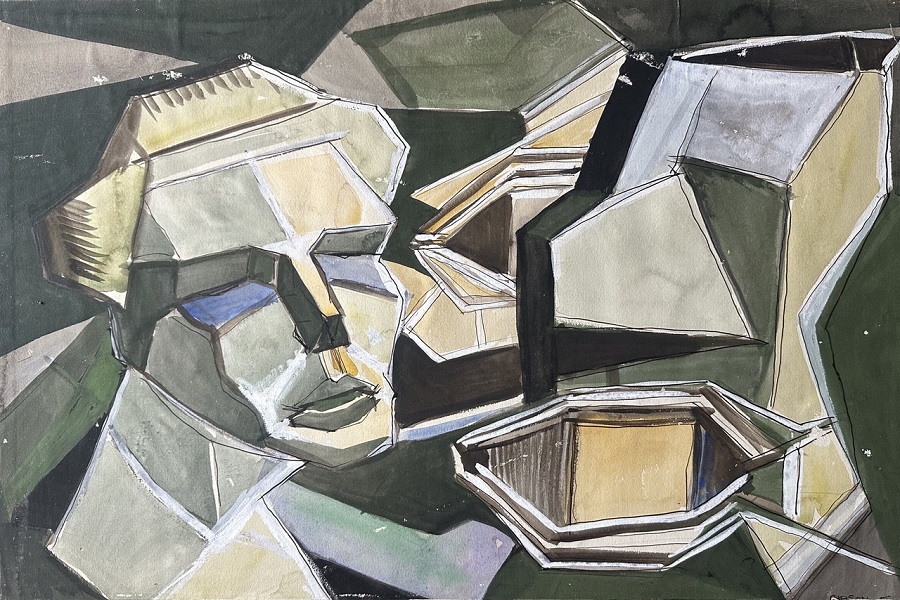
Croft’s tracks are mapped on to aerial photographs as in “Wave Hill Walk-off Track”. Nolan’s journeys are partly documented through his landscape photography and partly documented and/or imagined in geological-scale landscapes painted from an aerial perspective as in “Central Australia 9 January 1950”. Nolan’s vast aerial geology connects with Croft’s intimate geology by way of a kurrwa (stone axe). In both cases the creative impulse is intense.
Many of Canberra’s 2021 landscape exhibitions are of works which are mostly or entirely unpeopled. Phil Carter in the Huw Davies Gallery, Stephen Dupont in the Ambush Gallery and Mandy Martin in CMAG are current examples. It is a paradox. There are more Australians than ever before, but our artistic landscapes are often empty of people. Is there a creative Terra Nullius?

Croft sets people front and centre in her photographic landscapes. Nolan’s photographs and painted landscapes are very often peopled, as in the Ned Kelly series. For both artists, placing people in the landscape is a major creative and intensely personal concern.
Croft stresses history. Nolan knew history. Croft’s exhibition is about continuous indigenous presence in indigenous country. Nolan did not immediately place indigenous people in his outback paintings. Nevertheless, there is a large overlap in their historical understanding.
The juxtaposition of the exhibitions enables contemplation of the nature of personal connection to country by indigenous and by non-indigenous artists. In this space, Croft is confident and assertive. For Croft there never was a “Never Never”. Instead, there is an “Everywhen”. Nolan claims a deep personal connection with country. He states: “I find it more than beautiful. I get a tremendous source of energy from it. We all have totems, apparently this landscape is mine.” Note the ambiguity.
The question the exhibitions pose is this: “Must an artist belong to a group that owns country in order to form a deep, spiritual attachment with country, and so to create from within that country?”
I congratulate CMAG for this fruitful conjunction of the two exhibitions and acknowledge the input of CMAG senior curator, Virginia Rigney.
News all day, every day at CityNews.com.au.
Who can be trusted?
In a world of spin and confusion, there’s never been a more important time to support independent journalism in Canberra.
If you trust our work online and want to enforce the power of independent voices, I invite you to make a small contribution.
Every dollar of support is invested back into our journalism to help keep citynews.com.au strong and free.
Thank you,
Ian Meikle, editor


Leave a Reply